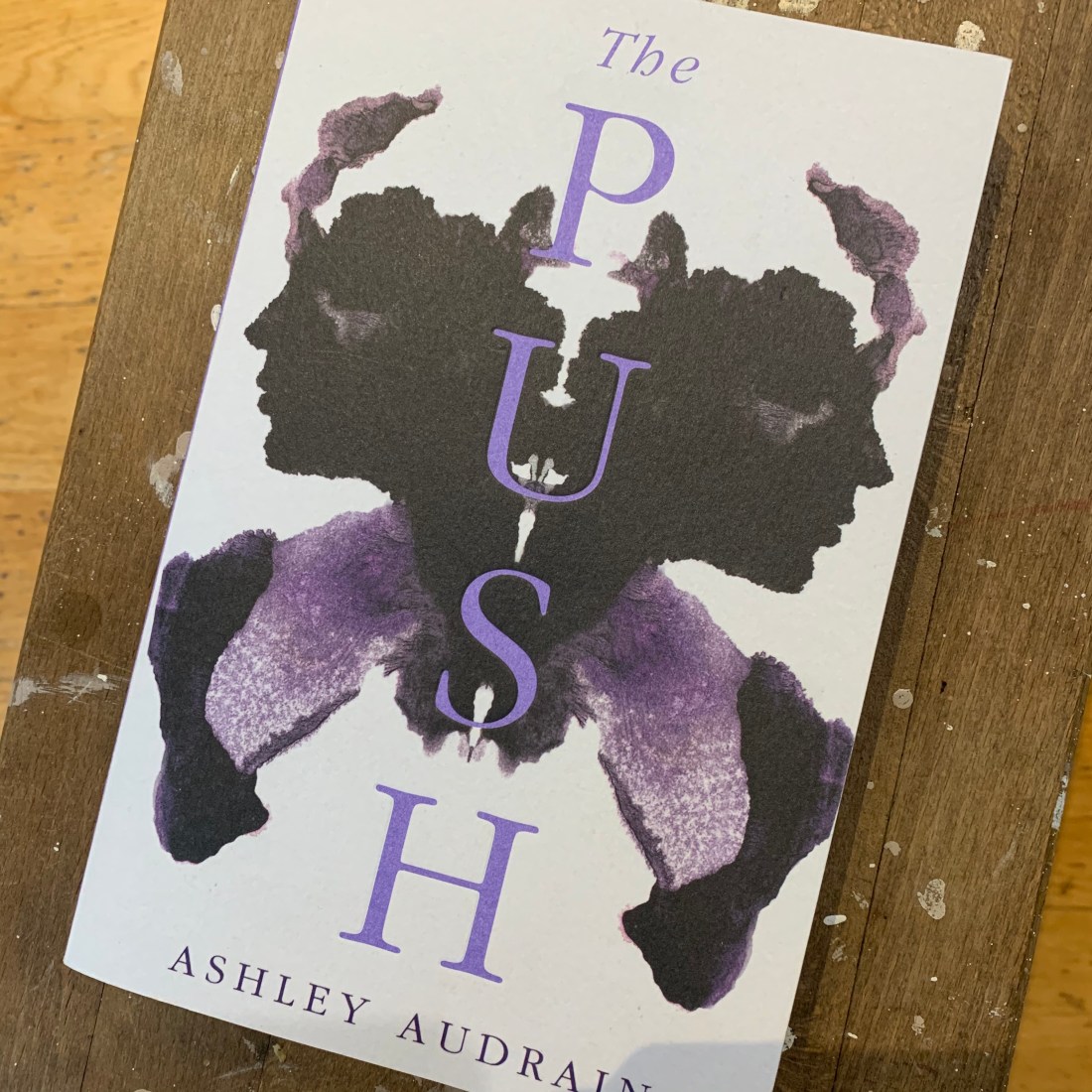
Book Review: The Push by Ashley Audrain

Back in the early autumn Amanda @Bookishchat sent a truly incredible book my way. I knew from all the accolades it was receiving on Twitter it was going to be good; so I stashed it away for my half term holidays and waited.

It wasn’t good; it was incredible. So incredible I wrote literally pages and pages of notes and have sat quaking since then, wondering how on earth I am going to write a review to convey what this book provoked in me as I read it.

But the time has come, this book is released in January by Michael Joseph Books and I need to add my voice to the chorus already predicting it’s deserved success.
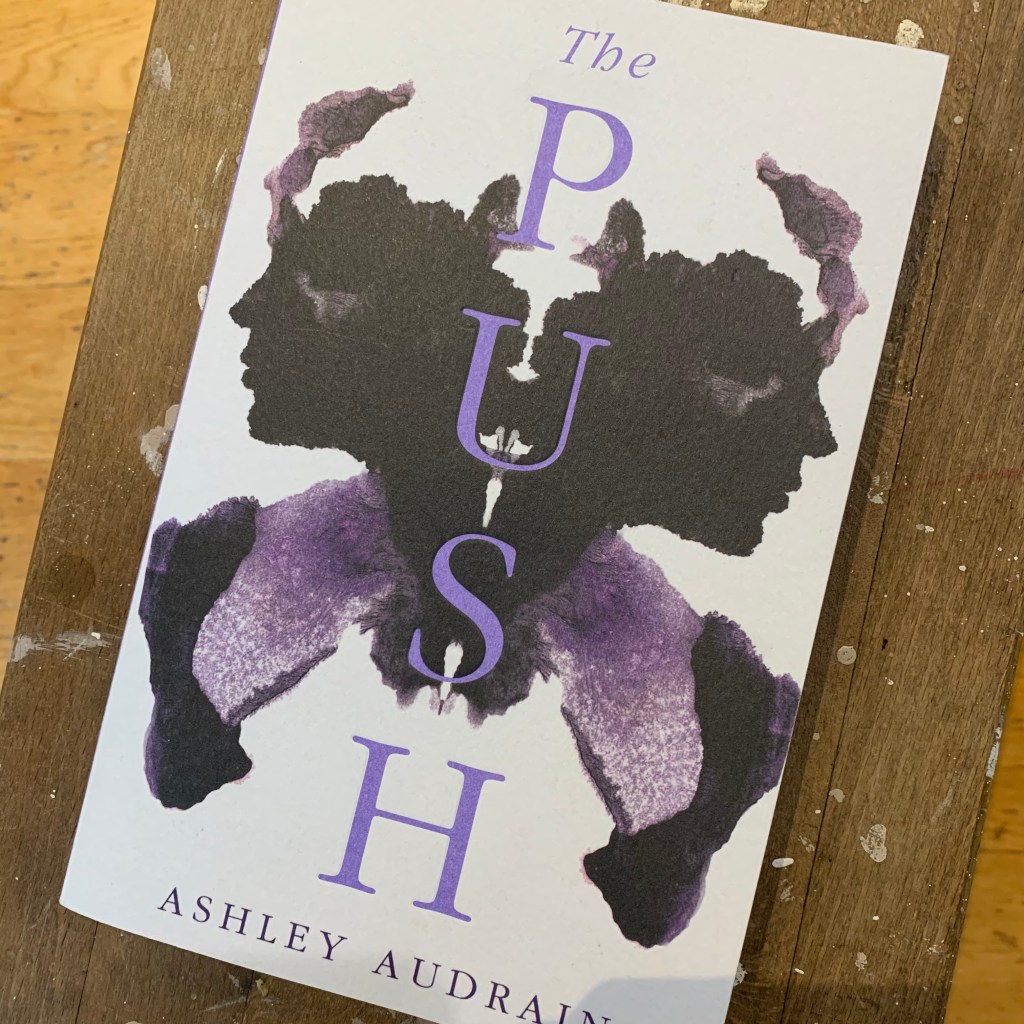
So what is the book about? Well in it’s simplest, most descriptive form it is the tale of three generations of mothers and daughters. Their narratives are woven throughout the novel. The main focus of the novel is Blythe and her own experiences as a mother and a daughter and how these are interlinked. Her narrative is told in the first person, it feels as if she speaks directly to you.

In essence this book is about motherhood. It examines every angle, every nook and cranny. The extreme highs and the dark lows; this is a story that is bound up in pushing the boundaries on that institution that society holds so dear, a story that probes at the edges of relationships and bonds.

From the first pages of this book the reader is challenged, you are pulled in and immediately find yourself dissecting the narrative and undertones of the story. From the outset there is an acknowledgement of how much physically and mentally motherhood can cost a woman.

Blythe might be the central character of this story, but her past experiences all feed into her narrative and her own experiences as a mother. Audrain lays bare traditional expectations and experiences. Through Blythe we feel the weight of expectation felt by new mothers. How giving birth can equate to a lack of control, control that is impossible to claw back. How society throws a blanket of perfection over motherhood, and perpetuates the lie of it being an inherent and natural process for all women regardless of age, background or personality.

Audrain acknowledges the weight of change that a baby brings to marriage and to a women’s life. She explores the very real sense of loss of self and identify, the changes to a relationship. There is a tangible sense of anger to this thread. So many times as a reader I was longing for someone to throw Blythe a lifeline, for someone to put a stop to the pretence that motherhood is easy, that it is some kind of competition, with winners and losers, and nothing in between.

Tantalisingly there are many moments when someone nearly says or does the right thing. When that fragile thread of solidarity, of hope that could change the course of actions is almost grasped. But no one ever quite probes deep enough or reaches far enough across the divide.

The narrative is multilayered and rich. Blythe’s past experiences and those of her ancestors highlight the different experiences of motherhood and how these feed into the experiences of children. The mental health of women and it’s lasting impact on the mental health of their children is explored in so many complex, critical and often dark ways.

The author does not shy away from the difficult and the uncomfortable, and while this story represents the highs and lows of mothering it is much more than just an honest and open account.

For this is also a story of that unique mother / daughter connection, and what happens when a mother can see something within her child that no one else seems to see. When a child is unique, even challenging, but the rest of the world does not see it, where does the responsibility for this lie? Or is it even a truth? Or is this brought about, even distorted by years of dysfunctional mother / daughter relationships? Who is to blame when motherhood doesn’t conform to the accepted norm?

There is just so much to say about this novel. So many ways to interpret and dissect the narrative, characterisation and themes. Even the title, The Push has so many different meanings. From the obvious links to the physical process of labour, to pushing through the dark encroaching days of parenthood, to later more specific and singular meanings within the plot itself.

This book is about to take the world by storm. It is a book that will challenge, often unsettled but it will stick with you and resurface time and again.

This one is not to be missed.

Rachel x
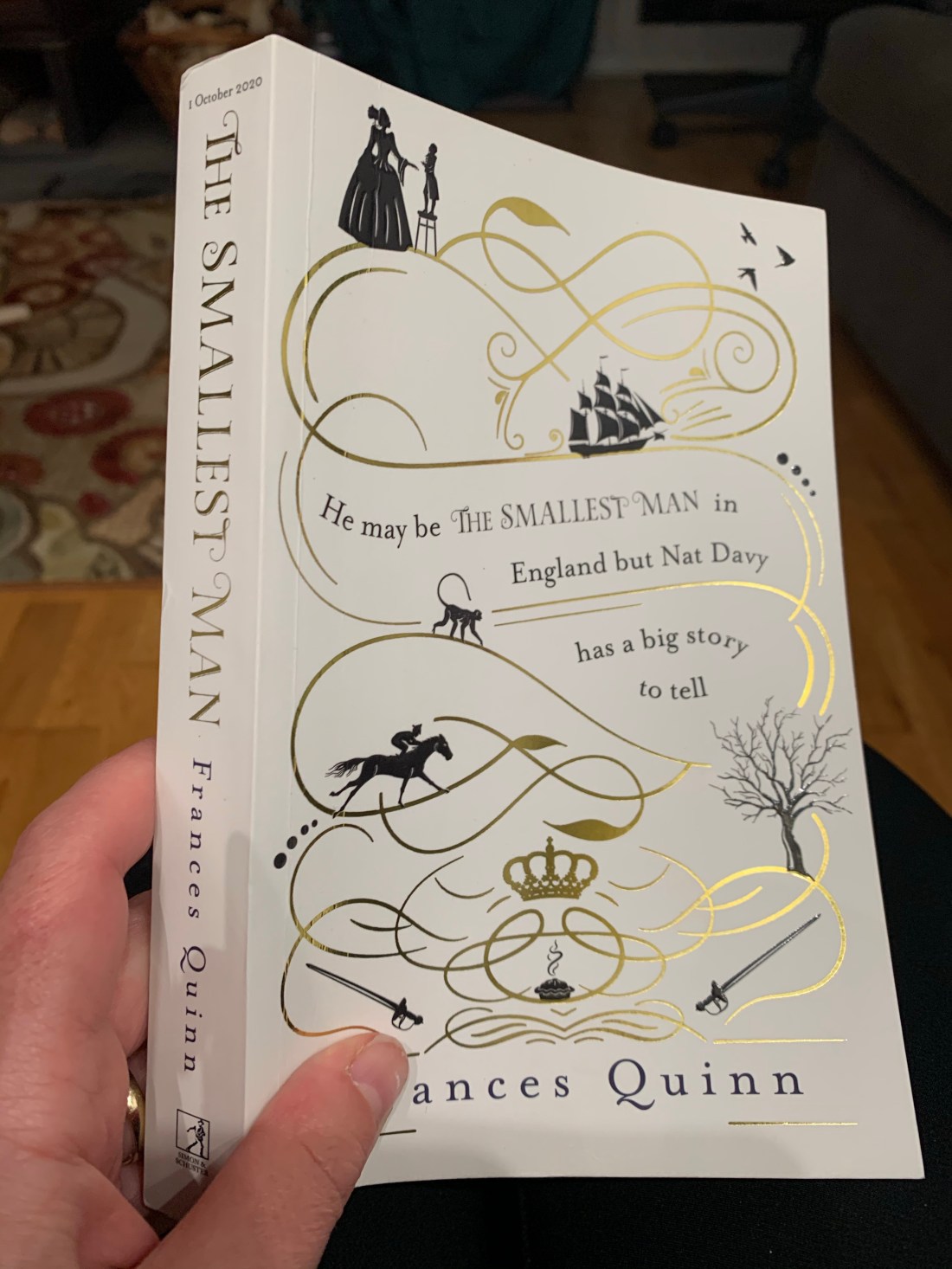
Book Review: The Smallest Man by Frances Quinn

I love historical novels. There is something comforting about being able to escape completely to a time far away, so finding a great immersive historical read always is always a huge pleasure for me. And The Smallest Man by Frances Quinn more than fits the bill.

The buzz around this January 2021 release has been building for a while and heartfelt thanks go to Jess Barratt for my gifted copy.

This is the story of Nat Davy. Growing up in Oakham, Nat has just one wish; to grow. To grow and be like the other boys in the village. To grow and be accepted by his father. To grow and start living the life he believes is waiting for him.

But destiny has other plans for Nat Davy. When it is clear that he has stopped growing, his father sells Nat, quite literally to the highest bidder. It is just a shilling that keeps Nat out of the travelling freak show and sees him dressed in finery and presented as a gift to the Queen of England.

In a giant pie no less!

Finding himself at court, Nat strikes up a relationship with the young lonely Queen. Both have been torn away from their families, both labelled as outsiders; Nat for his size, the Queen for her religion. Both have something to prove.

Becoming widely known and accepted as ‘The Queens Dwarf’ makes Nat his share of both friends and enemies, all of whom will help to shape his fortunes. And when after years of luxury but growing unease, the country descends into civil war Nat finds his allegiance to the Crown puts him in danger.

The Smallest Man is a story that will stay with you. On a personal level it was a story that brought to life the period around the English Civil War; a period I knew very little about. But this story in it’s own right was a triumph. From the off it was entertaining and alive. It is a narrative filled with vivid characters, believable and authentic, and all provoking strong reactions.

It is a story that flits across the continent and through time, harbouring fortunes that change quicker than the blink of an eye. This is a story filled with action and pace, but also with a depth that grabs your attention throughout.

It is a story of courage and opportunity, both of which are found in the most unlikely of places. It is a tale of what can be achieved when you challenge expectations. A tale of friendships made in unlikely places and how kindness well placed will be repaid in kind

And it is the story of what happens when you learn to love your own being and accept that different doesn’t equate to inferior.

Quite simply I loved this book. January 2021 is in for a treat!!

Rachel x

The Smallest Man by Frances Quinn is published by Simon and Schuster on 7th January 2021

#BlogTourReview: The Stone Diaries by Carol Shields

It is more than a pleasure to be taking my turn on the blog tour for The Stone Diaries by Carol Shields. I first encountered this wonderful author when I read Larry’s Party many years ago. Carol Shield was a writer of impeccable timing and insight; some one who could get to the heart of the human condition and bring the magic of life to a wide audience. She was particularly skilled in her portrayal of women. She saw the joy in the everyday and brought those stories to life.

The Stone Diaries, first published in 1993, and now reissued by World Editions is widely regarded as Shield’s masterpiece. It’s reissued coincides with the launch of the first Carol Shields Prize, created to honour women in literature.

The Stone Diaries is the story of one women’s life through out the Twentieth Century. Spanning major historical events and travelling between Canada and America, with a little bit of the Orkneys thrown in, the novel concentrates on the life and evolution of Daisy Goodwill Fleet. From her unexpected and eventful birth, through to her death we follow Daisy, through each era, incarnation and event.

The sense of perspective within the novel is unusual and ever changing. Shields seems to both acknowledge, play with and disparage the notion that a life is seen and judged through many windows, often not those best informed. Any perception or judgement of an individual is tainted by our own views or preconceived ideas; and as such how close do we get to knowing the truth of some and their life.

Daisy’s story appears symbolic of many women of the past twenty years. At times she seems in control of her own destiny, at others very much trapped and defined by the role she finds herself in. As a daughter, mother, wife, it seems that society has a place for Daisy. But who is the real Daisy Goodwin Fleet?

With her usually eye for detail, Shields builds up layer upon layer of information and insight. Some seems domestic, easily dismissed as trivial, but it is this pinpoint accuracy that gives the novels it’s depth of perception and marks Shields out as a compassionate and empathetic mouth piece for Daisy and hundreds of women like her.

Beginning with Daisy’s stone mason father, who is devoted to the memory of his wife, devastated by her loss, the motif of lasting memorials runs throughout the book. How do we choose to spend our lives with someone? How do we evaluate and express their worth? And what testaments do we raise to them after they have gone? Shields poses all these questions and more, pushing at the edges of the readers responses for answers, showing us how one person, one life lived can be so different in each different interaction and at different times of their lives. Shields quietly and insightfully questions the markers we use to evaluate a life and questions whether we can ever truly know someone entirely.

This is a novel that begins in both birth and death, and comes full circle. It is a novel that challenges us to look for the extraordinary in ordinary and reevaluate what we might find there. It deserves every accolade and truly is a modern classic.

Rachel x

And there is more…

For more reviews and responses to this book, please check out the rest of the blog tour, listed below…

#November Wrap Up…

Hello and welcome to the last month of the year! I don’t know about anyone else but in the whole surreal experience that has been 2020, this month has felt like the toughest.

Dark mornings and evenings, colder weather, lockdown and Covid just getting just too close for comfort on more than one occasion has made this month feel like a bit of a slog. I haven’t read anywhere near as much as I wanted but I have tried to find escape and refuge in the books I have read.

A highlight of this month has been some of the cracking book post I have received. I am honestly overwhelmed by the generous nature of publishers, publicists and authors. 2021 is going be a cracking reading year!!

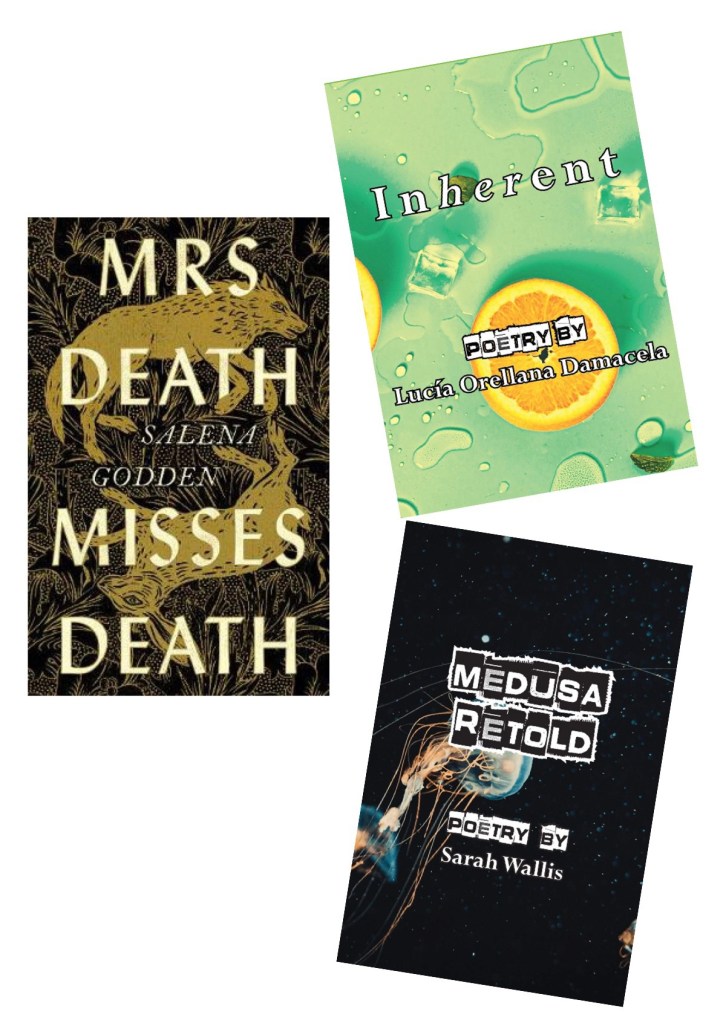
And on the theme of amazing 2021 reads let me introduce you to Mrs Death Misses Death by Salena Godden. This book just blew me away!!! Original in style, subject matter and structure, it’s a rocket waiting to launch. Full review coming later this month but it’s going to set January 2021 on fire!!

A couple of other books awaiting a full review and just finished Medusa Retold by Sarah Wallis and Inherent by Lucía Orellana Damacela. I repeatedly say I don’t read and review enough poetry so I thrilled to be offered these two books by Fly On The Wall Press. Both unique and beautiful in their own ways; my full review will be up next weekend.

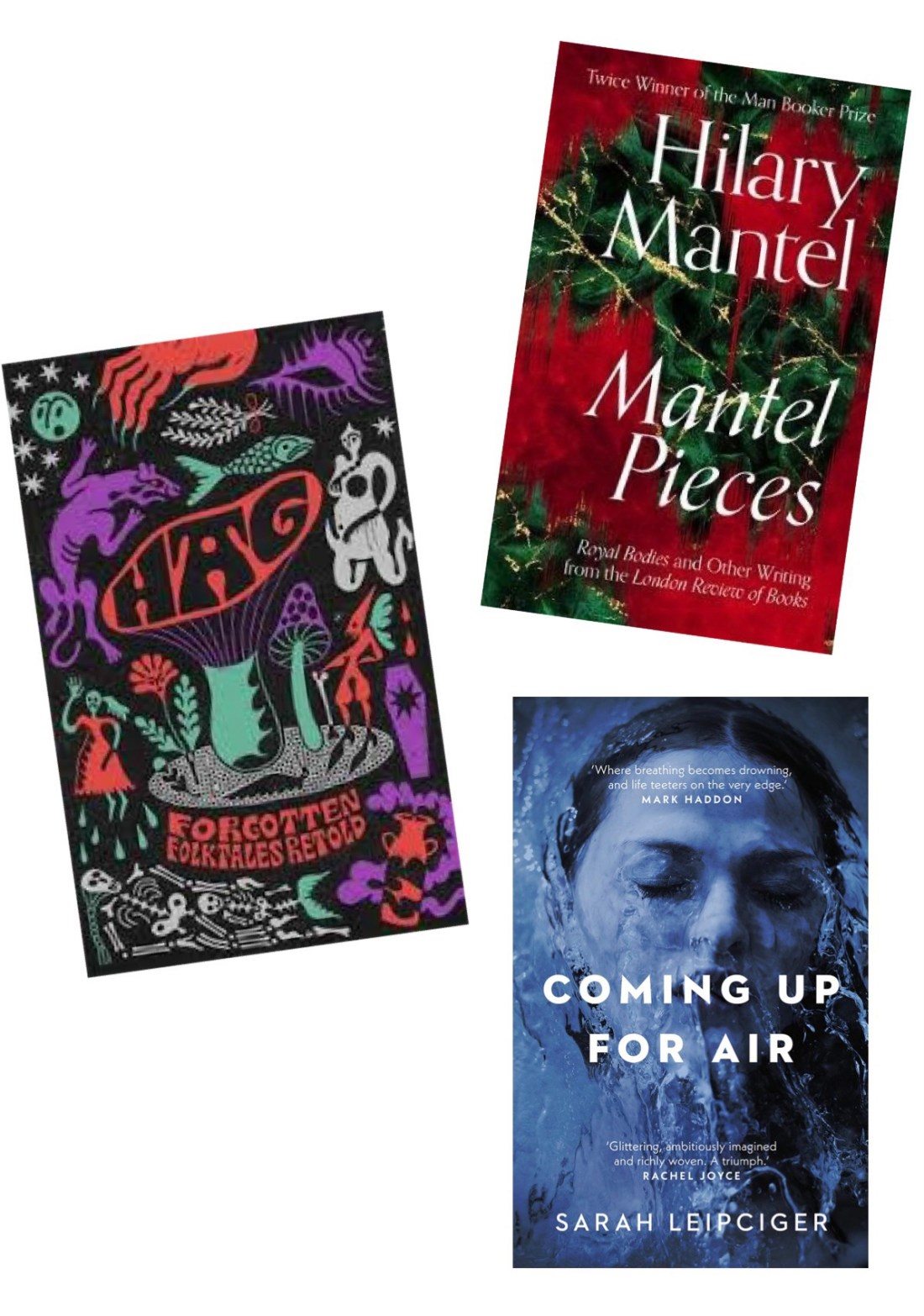
Poetry has given me the perfect opportunity to dip in and out of reading material when my concentration is not what it should have been . Another ‘dipping’ book which had been with me for a couple of months now is Hilary Mantels Mantel Pieces. A stunning collection of her articles and essays, written with her usual wit, insight and intelligence. Quite simply a joy.

Another joy was Hag: Forgotten Folktales Retold. Emma, @corkyyorky, told me I was going to love it and I did!!! Authors Daisy Johnson, Kirsty Logan, Emma Glass, Eimear McBride, Natasha Carthew, Mahsuda Snaith, Naomi Booth, Liv Little, Imogen Hermes Gower, Irenosen Okojie retell British Folk Takes, and they are stunning. The accompanying Audible podcasts are a must listen and getting me through the dark mornings as I drive to work.

Another ‘Emma’ recommendation was Coming Up For Air by Sarah Leipciger. Set across three time periods, told in beautiful lyrical prose, here is a story that converges with skill and precision.

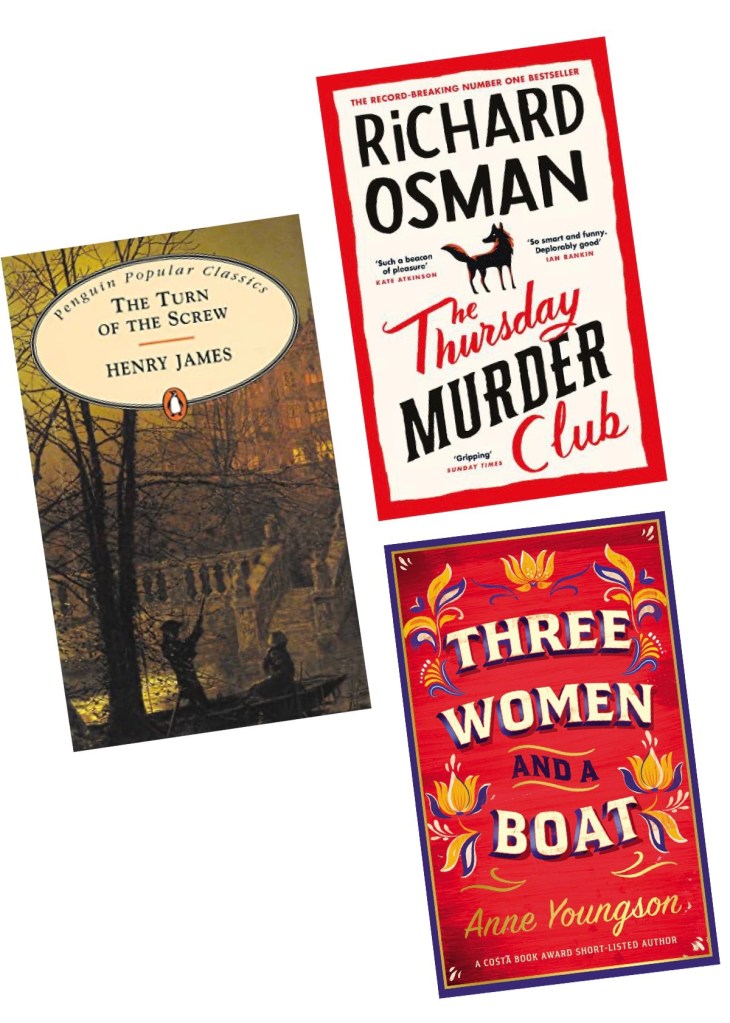
Talking of recommendations Richard Osman’s Thursday Murder Club has been raved about in every bookish quarter!! And now I see why! A perfect blend of wit, style and entertainment!! This is going to under a fair few Christmas Tress this year!

My book club read this month was The Turn of The Screw by Henry James. For a slim book it took some getting through!!! One more classic read chalked up, but won’t be a reread!

My final read of the month was the tranquil trip along the canal found in the novel Three Women and a Boat by Anne Youngson. My mini Insta review can be found here

Bring on December!!!

Rachel x

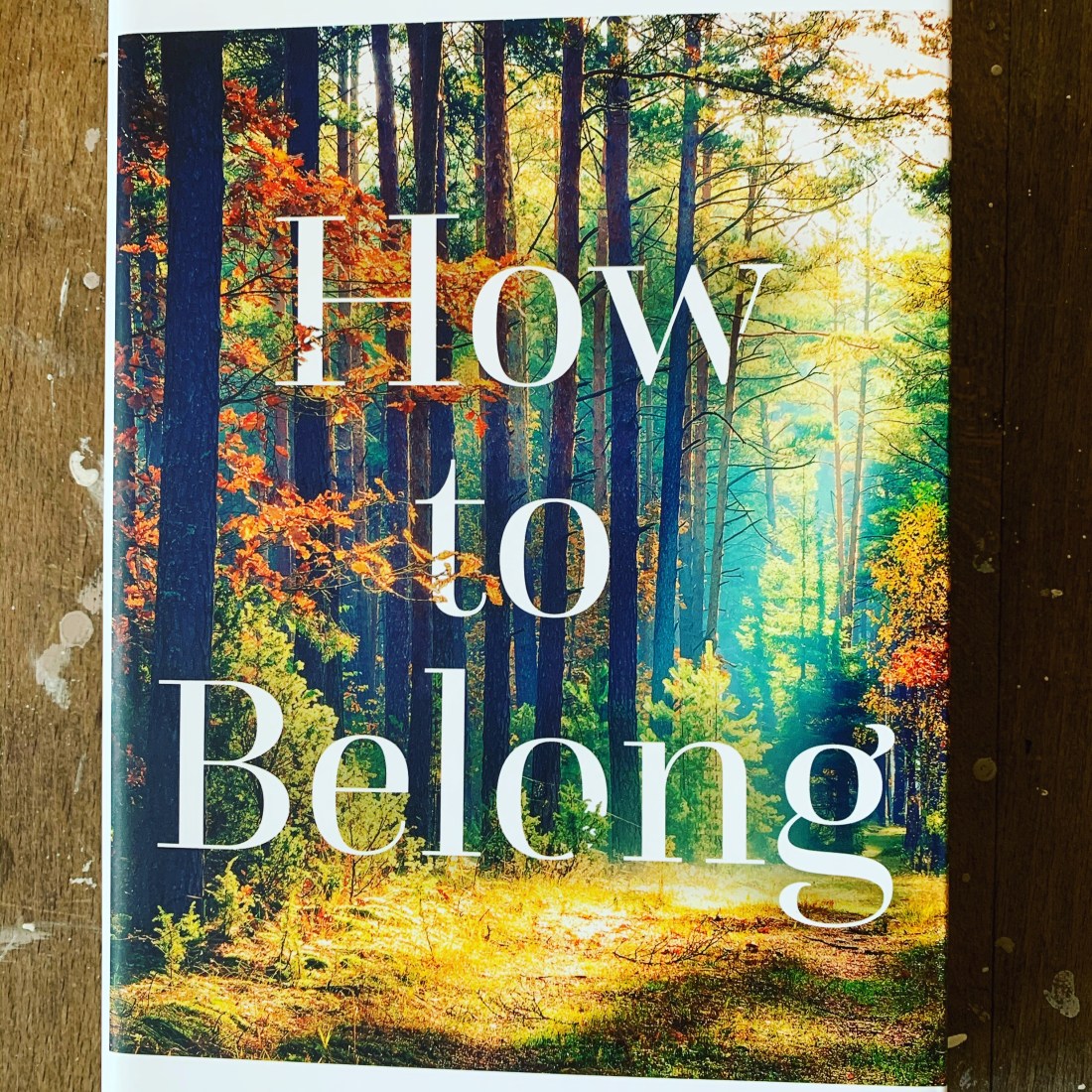
#BlogTour Review : How to Belong by Sarah Franklin

Today it is my turn on the blog tour for Sarah Franklin’s latest release, How to Belong published by Zaffre on 12th November. And I am thrilled to be able to add my own small voice to the avalanche of warmth and praise that is, quite rightly, wrapping it’s self around this book.

This is the story of two women, both at turning points in their lives, both trying to establish a sense of belonging. It is a feeling that life has slipped through their fingers and they are desperately trying to reconnect.

Jo Butler, was born and bred in the Forest of Dean. Her parents, stalwarts of the local community, have run the family butchers for years. Her hometown is a constant in Jo’s life, a place to return to, away from her legal career in London. Jo is the local girl made good.

But when the family business is due to be sold, Jo feels like her safety net is slipping and all her insecurities about her own unsatisfyingly career bubble up to the surface. She persuades her parents to give her a trial period running the shop and she moves back home.

But the question that quickly rears its ugly head is , is this actually home? Does Jo still belong in this community and does the connection she craves with her long term friend Liam, the Forest and the shop still exist?

Tessa is the local farrier and Jo’s landlady. She operates on the edge of the community and her sense of belonging seems permanently adrift. Tessa is struggling in every sense of the word and living a closed, half life in an attempt to protect herself and her secrets.

The two women are brought together by circumstance and although their situations seem miles apart, they have more in common than they think. Their stories of attempting to move forward and find their way become interwoven, in a narrative that is filled with authenticity and empathy.

This is a novel rich in a sense of place. Both the physical place of the Forest of Dean, which provides a tangible and beautiful backdrop to the story within these pages. But also the sense of place that comes from knowing when you are home, and how dislocating and disturbing it is when the things you have taken for granted, the bed rock on which your very being is build, suddenly seem to shift away from under your feet.

Sarah Franklin frames difficult and all too familiar questions within this story. For example, how far is our own identify tied up with our sense of place and past? Can you ever truly return to a time and space to find answers to the present ? And what happens when life changes before you are ready to move on?

The story of Jo and Tessa, both individually and together, will linger long after you close the final chapter. This is tale of looking in, before you can look out.

Rachel x

And there is more…

For other reviews and reactions to this beautiful book, check out the rest of the blog tour, detailed below…

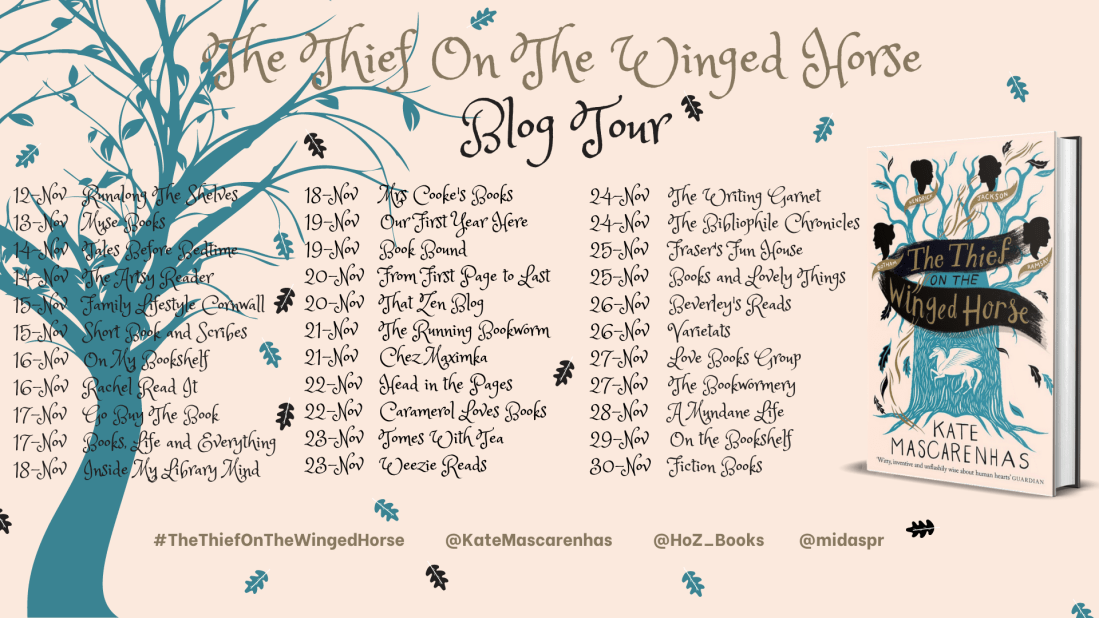
#BlogTour Review : The Thief On The Winged Horse by Kate Mascarenhas

If you are looking to inject some magic into your life this winter, then look no further than the enchanting and evocative read that is The Thief On The Winged Horse by Kate Mascarenhas published on 12th November by Head of Zeus.

It’s always a promising sign when I finish a book in day, pushing aside all other chores and commitments to lose myself entirely in it’s pages. It’s an even better sign when the plot, character and general magic of the book in question are still dancing around my head several days later. It was hard to pull myself from the world created by this book, but for all the right reasons.

Welcome to Kendrick’s Workshop; a firm specialising in the creation of enchanted dolls since 1820. The firm was established by four unique women; the Peyton sisters, whose own births were shrouded in an air of magic and mystery. The four sisters; Lucy Kendrick, Rebecca Jackson, Sally Botham and Jemima Ramsay all married, but Jemima died young and left no heirs.

Fast forward 200 years and Kendrick’s is still trading, it’s dolls, each bearing it’s own particular enchantment or ‘hex’ are collected across the world. The business is tucked away on the Eyot, a small river island in Oxford. Only descendants of the four founding sisters are employed here and the community that has grown up around the company is insular, cloaked in traditions, festival and an unchallenged hierarchy which hands all the power to men.

For despite the creation of the company being down to four gifted and powerful women, since their death only men are allowed to work as sorcerers with the workshop. Women are employed in various capacities such as dolls house creation, working in sales but they are forbidden from obtaining the prized position of making and enchanting the dolls the world covets.

Every male descendant of the Kendrick’s sister is bestowed one hex on his thirteenth birthday, and it is his to lay upon a doll of his creation. In a continuation of the patriarchal hierarchy that runs through this community each daughter’s hex is given to her father and only shared at a time of his choosing.

When we step onto the Eyot in 2020, there is a feeling of change in the wind. Conrad Kendrick, descendant of Lucy Kendrick is head of the firm. At war with his alcoholic brother Briar, Conrad is the undisputed ruler of the Eyot. His housekeeper Hedwig, is young and ambitious and is making herself indispensable by attending to Conrad’s every need. She is intelligent and wily and looks for opportunity to work within the system for her own empowerment and gain.

Persephone Kendrick, Briar’s daughter is frustrated. Deprived of her hex by her father she works in the company shop, but is desperate to fulfil her ambition of working as a Sorcerer. She, like many on the Eyot, is discontented with her lot on the island and is straining at the boundaries of what is accepted.

When a young, charismatic and talented doll maker by the name of Larkin arrives in their midst the community and it’s order is shaken to it’s core. Larkin seems to possess proof that he is descended from the younger and childless sister, Jemima. Conrad takes Larkin into the firm, employing him as doll maker. He is, however forbidden the knowledge of enchantment.

Larkin and Persephone, drawn together by a common goal, strike up and alliance. And when the rare and priceless doll ‘The Paid Mourner’ is stolen from under their noses the order of Kendrick’s is threatened. Conrad is of the belief that the doll has been taken by the fae folk, a long held belief in the community. Tales of the mysterious Thief on a winged horse have provided the basis of the customs and way of life on the Eyot for hundreds of years. It is the disappearance of the doll that provide the catalyst for the events that follow.

The Thief on the Winged Horse is a skilled tale of female empowerment, of women reclaiming their birthright in a world of tangled belief and tradition that seek to deny them. The story and it’s telling weave together a curious and beguiling mix of fantasy and ordinary. The tale might be set in the modern day but it is rich and alive with feelings of other worlds and a time gone by.

Here is a skilled and tangible feeling of reality and fantasy intertwined, a feeling that this all this magic, enchantment and unsettling beauty could be found amongst us, if only we had the skill to find it.

As well as being a tale of magic, it is a tale of duplicity and deviousness operating both within the close circle of the Eyot and the world beyond. It is a narrative driven forward by many varied and carefully constructed agendas and intrigues. It is a fable that teaches us about the imparting of knowledge and the power it brings. It has things to say about equality, what true equality means, and how the pursuit of equality is bound tightly to the welcoming of truth and self discovery.

The Thief on the Winged Horse is truly unique. It is a beauty of a book and it has been my absolute pleasure to support it’s journey into the world by taking part in these blog tour. I recommend that you inject a little magic into your lives this Christmas by getting this one on your wish list.

And there is more…

For other reactions and review to The Thief on the Winged Horse check out the rest of the blog tour listed below…

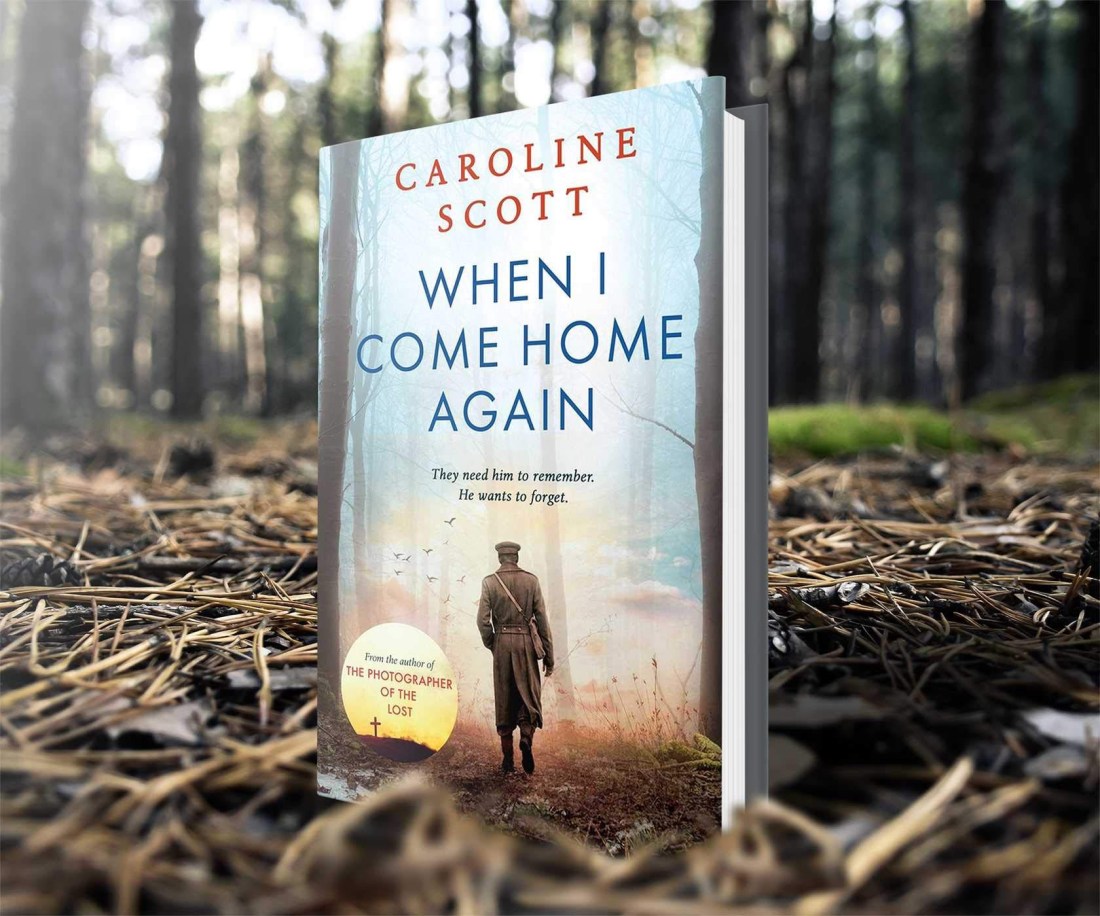
#BlogTour Review: When I Come Home Again by Caroline Scott

Last year I read a beautiful, thought provoking book called The Photographer of the Lost by Caroline Scott. Set in the period of and immediately after the First World War it was one of those books that stayed with me. It took me to places I hadn’t been and gave me knowledge and perspective I didn’t expect. So when Anne Cater invited me on to the blog tour for Caroline’s latest book When I Come Home Again I jumped at the chance.

In her second novel Caroline returns to the First World War. We begin in the final week of the war, when a soldier is arrested in Durham Cathedral. Scared, confused and totally alone, ‘Adam’ as he is named, has no memory of who he is or where he has been.

He is released to the care of James Haworth and his superior Dr Alan Shepherd, both specialists in treating men traumatised by war. Adam is taken to Fellside House in the heart of the Lake District where his therapy begins. Over the course of years there seems to be little progress. Adam shows an innate empathy for nature and skill for tending the overgrown gardens, as well as a talent for drawing but he is unable or unwilling to open the locked box of his past.

When, two years after the war, an article about Adam runs in the national press, three women come forward to claim him as their own. Celia is a mother, stuck in time, still believing that Robert her son will come home. Anna has been running the farm single handedly since her husband Mark left abruptly for war. Lucy is struggling under the weight of raising her brother’s children after he failed to return from the front.

Each women has a credible case, each women is convinced that Adam belongs in their lives. But Adam is unable to wholly connect with anyone. The only tangible clue to his past is the face of a women he draws over and over again, a woman he claims has revisited him in the woods that surround Fellside House.

The effects of war are beautifully and painfully presented here not only in the character of Adam and the other men who are treated at Fellside. Beyond just these collection of men Scott has created a cast of characters that are all touched, even years on, by the four years of fighting and absence. Each of the women who come forward to claim Adam have a story to tell; a story of loss, of struggle and of learning to cope in a world that will never be the same again.

Effects of the war radiate through and permeate each character and each strand of this beautifully woven story. James might be striving to fix the men in his care but he too has been left broken by the horrors of war. Haunted by his experiences in France and visions of the death of his brother- in- law, Nathaniel, James is slowly unravelling. His night terrors and daytime drinking are pushing his wife Caitlin further and further away. He is trapped in his memories as much as Adam is trapped by his inability to remember.

This novel is a sensitively and beautifully crafted tribute to those who survived. It examines in detail, through individual stories, the aftermath of war, the changes that it wrought on society, both on a national and individual level and acknowledges that loss, grief and death did not end on the final day of the war. This is a story of afterwards. Told without sentimentality but with swathes of empathy and realism, these characters tell their own tales of trying to move forward in a time when every has changes beyond recognition.

When I come home again is a portrait of memory. Of how each of us remember in different ways, how each of us construct and hold those memories close to help us cope with events and the world around us. This novel also asks the question of what happens when memories fail us. Not just by refusing to unlock their secrets, but also by distorting and dominating our present. Each character in this book is held in time by the past, one way or another.

This November, over 100 years since the end of The Great War, I heartily recommend you take some time to read this novel and consider the legacy of the war. I guarantee that this story will hold you still and will linger long. And that is just as it should be.

Rachel x

And there is more…

For more reactions and reviews, check out the rest of the blog tour, listed below…

#BlogTour Review: The Once and Future Witches by Alix E. Harrow

Last year I read and fell in love with Ten Thousand Doors of January , Alix E. Harrow’s debut novel. So when I was given the chance to join the blog tour for The Once and Future Witches I jumped at the chance. Grateful thanks as always to Tracy Fenton of Compulsive Readers for my invite.

This book is astounding. Let me just get that out there right at the start!! Set in 1893, in New Salem, it is the story of three sisters. Born in poverty, with an unpredictable and abusive father the Eastwood sisters are used to living on their wits. Bitter necessity and circumstance have divided them but now they are unexpectedly reunited and there is change in the air.

As the novel begins James Juniper Eastwood, the youngest and most fiery sister, has arrived in New Salem. She is a fugitive, wanted for murder and witchcraft in her home town. A chance and strange meeting brings all three sisters together.

The sisters, James Juniper, Beatrice Belladonna and Agnes Amaranth are currently divided by circumstance and fear. Beatrice is working as librarian, Agnes is a mill worker. Unlike their rebel sister they are trying to bite back the witchcraft and power of their ancestry and keep a low profile in a city which has a history of persecution of witches. For New Salem is build on the site of Old Salem, and in this novel Old Salem was burnt to the ground at the end of the infamous witch trails hundreds of years previous.

New Salem is currently is in the midst of political change. Fighting a mayoral election is the unsettling and shadowy figure of Gideon Hill whose proclamations against witchcraft create fear and suspicion. And at the same time there is a powerful call to arms by the women of the city, as the suffragette movement grows and women all over the world begin to call for the vote.

When Juniper joins the fight despite her sisters’ initial reluctance and fear, despite the differences between them, their sisterhood and their shared inheritance come together. Women across the city from all backgrounds, classes and racial divides start to rediscover their lineage.

Women’s very names reflect the legacy of their parents. Each women has two names; their first name is given by their father, but their second and more powerful name is given by their mother. Juniper from the beginning shuns her patriarchal name, taking the maternal line and embracing it. Beatrice, on the other hand moves between the two, changing as the novel and her experience progress.

The power of women past is found in the words passed down from mother to child. Fairy stories are redefined by their very nature as Witch stories and the women of New Salem begin to reclaim their power. The words muttered by grandmothers and mothers are reestablished as spells and retellings. They pepper the narrative, giving it a rich sense of history and being, grounding it in folk lore and all our shared histories. And they give the women power to rise up.

Here they find the power of women, encapsulated in their shared oral history. There is true and grounded sense of women reclaiming a power lost to them.

Women’s rights run throughout this novel like its life blood and in every form. This unique narrative encompasses all manner of women’s issues . It faces head on issues of gender, sexuality, abortion, equal pay, sexual harassment and domestic violence. In a seamless and powerful story, fantasy and history are woven together. For example just like in the historical record of women’s struggle for suffrage there is disagreement and discord about the way to proceed.

Alligences are uncomfortable and there is mistrust even between the three sisters and others; take, for example, the mysterious black lover of Beatrice, Cleopatra Quinn. The reader is forced to continually question who such characters really are, what is their motivations and where do their loyalties lie. Equally the chaos these women create in their wake has more than echoes of the disruption caused by the ‘real life’ suffragettes. The witches network of safe houses, and constant movement between sympathetic patrons reflects Mrs Pankhursts days of evading arrest by flitting from house to house.

It is worth noting and indeed important to do so, that this novel doesn’t offer up a clear divide on the basis of sex. Throughout the novel witchcraft is not portrayed as solely the device of women. Men can practise witchcraft too. But the important take away from this novel, the message that we have seen time and time again throughout our history is that when it is practised by men, that is, when men have the power, it is some how sanctioned. The power and the possible corruption that comes with witchcraft is allowed for men. This story encapsulates that long held and still present double standard; that power in the hands of men is expected and strong, in the hands of women it is somehow tainted and unnatural.

This novel is a handbook of female power and rebellion. In modern times when the outgoing President of the US says openly there will not be a socialist female president this novel feels like a mystical call to arms. I am tempted to send Kamala Harris a copy.

And there is more…

For further reaction and reviews of The Once and Future Witches by Alix E. Harrow check out the rest of the Blog Tour below…

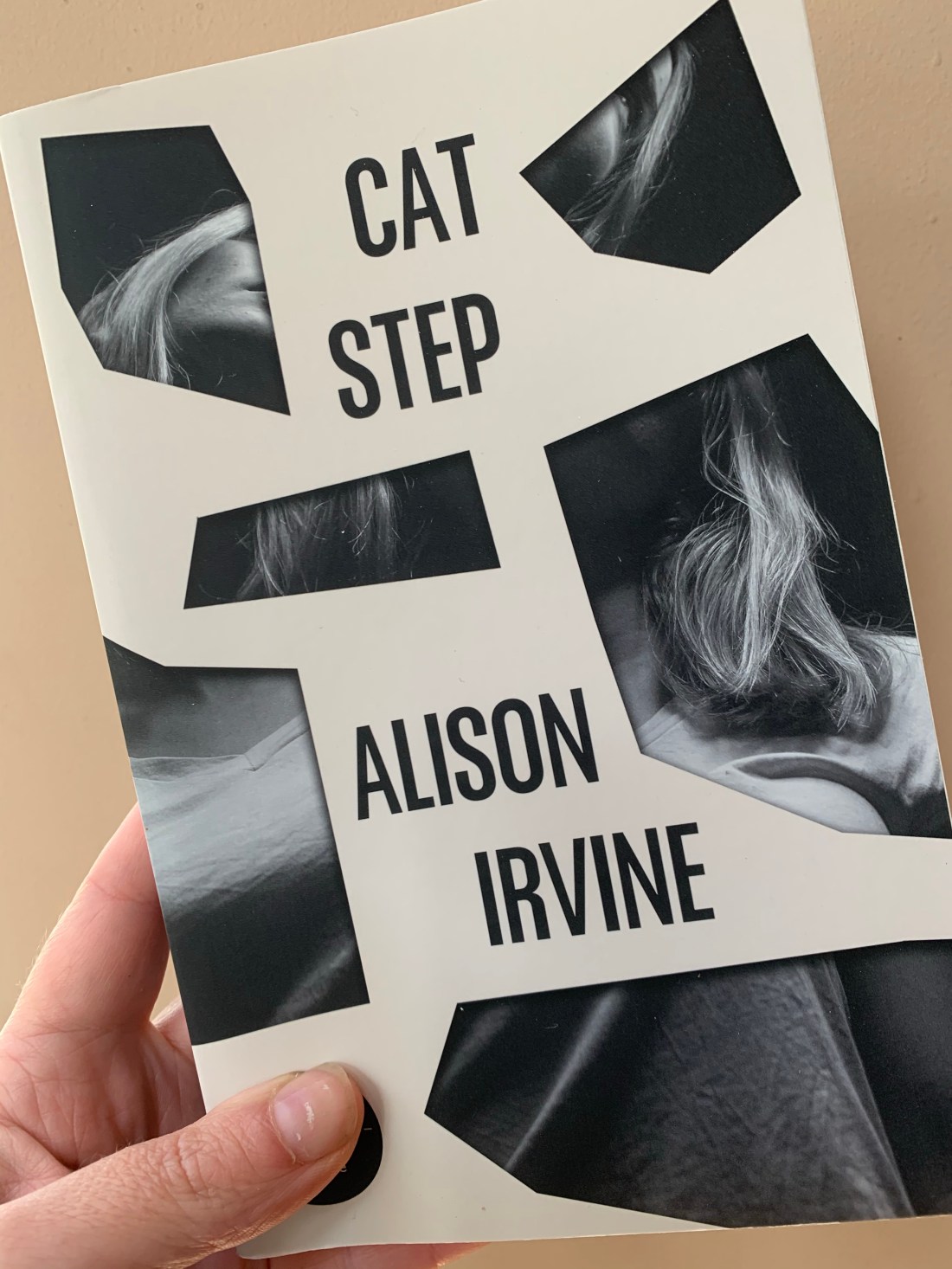
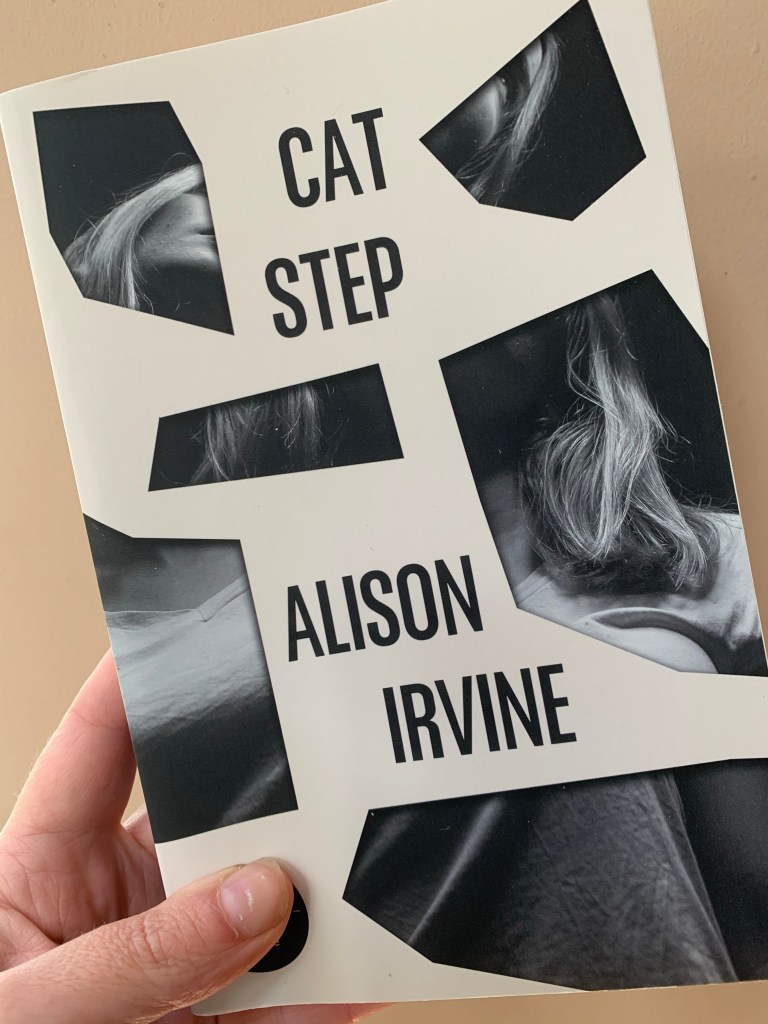
Book Review: Cat Step by Alison Irvine

I have said it before and I will say it again, sometimes blogging and the book blogging community leads me to a book that I would never have stumbled upon otherwise. This very definitely the case with Alison Irvine’s recently published novel Cat Step. I am grateful to Jordon Taylor- Jones for my gifted copy. It arrived on Saturday and was read, cover to cover, by Sunday afternoon.

This is the story of Liz, a talented dancer who previously made her living and also found the love of her life working on cruise ships. Yet when we meet her that golden time seems long past. Recently arrived in Lennoxtown, Liz finds herself making a spilt second decision with far reaching consequences.

Her four year old daughter Emily is unwell, and has, after a fitful night, has fallen asleep in the car on the way to the local shops. Exhausted, harassed and unsupported, Liz decides to leave her daughter sleeping in the locked car while she runs into the shop. But when a thief tries to break in this decision comes to everyone’s attention and defines Liz’s arrival in the sleepy Scottish town.

Told from Liz’s perspective we see first hand the challenges a young and fragile mother faces as she tries to come to terms with a life she never expected and all the things she has lost. It is the absence of Emily’s father, Robbie that has brought Liz to this remote place, far from the support she has in her native London. And it is the pursuit of truths both in her own past and that of others that will either move her forwards or push her further under.

There is no doubt that Liz is struggling; struggling to connect with her young daughter, struggling to find direction in a life that hasn’t turned out the way she planned and struggling to find someone who she can trust to confine in and help her find a way through.

This is a novel that looks at the small choices we make every day, the choices that we make unwittingly, those actions we take at times of great change or under great pressure. This novel examines and highlights how those choices stack up and how they might appear to other people looking in. This novel focuses on how judgements attached to these choices can be life defining and life limiting and throw us onto a entirely different course.

Liz is a character who is entirely believable and familiar. Written with empathy and skill the author lays bare motivations which are easily identified. As a reader we follow the trajectory of Liz’s experiences and choices, sometimes with a sense of hope, sometimes with despair. The people she encounters in Lennoxtown give of themselves sparingly and only a piece at a time. At a time in her life when Liz needs, even if she can’t acknowledge it, a level of support and understanding the reader is left wondering is she will find the stability and answers she needs.

This is a simple story and yet at the same time one driven by complexity and confusion. This is the story of how life, experience and grief can blur all those red lines and make the unexpected and unthinkable a sudden and unlooked for reality.

Rachel x

Book review: Walter and Florence and Other Stories by Susan Hill

The thing I love about Bookish Twitter is that you discover new and unexpected gems every single day. A few weeks ago I responded to a tweet from writer Susan Hill, asking for book bloggers to be in touch. Under a week later I was sat in my garden, enjoying a copy of her latest collection of short stories.

Walter and Florence and Other Stories was published on 10th May 2020 by Long Barn Books, and for short story lovers it is a must read.

This is a collection of ‘real’ stories. This may seem a strange thing to say and maybe it is. But what I mean by this is that from the beginning I was enthralled by each tale , I was captured. I wasn’t looking for the deeper meaning, my attention wasn’t wondering, I wasn’t even pausing to make notes.

I was just enjoying that simple but honest pleasure of being told a good story.

The subject matter found within the collection is diverse, and showcases the author’s skill, experience and versatility as a writer. There is a gentleness, and a beguiling charm to the stories that are woven here. There isn’t a story in this collection which I was able to break away from.

To those of you who have read, and marvelled at Hill’s The Woman in Black it will come as no surprise when I tell you that the two ghost stories within this volume are special.

The title story Walter and Florence begins as the tale of a quiet domestic life. A couple drawn to each other, childless but happy; their marriage is the very model of ‘for better, for worse.’ But when one spouse dies, the other is left vulnerable. The ending is unexpected but triumphant. And steeped in the supernatural.

The Quiet House again centres around a widow. Lost, lonely and barely recovered following the death of his beloved, the unnamed widow takes refuge in the The Quiet House, trying to escape the demands of Christmas. But what he finds there is most unexpected. So too is what he discovers about himself.

There is a feeling in several of these stories of a reawakening. Of characters finding answers, or even asking new questions; a sense that a life they thought was mapped out for them might not be as secure as they thought. For example in Irish Twins we see Fern struggling to find her place in the world when the ties between her and her sister begin to break. This is the bond she has always relied on begins to give her life shape and meaning. How does she move forwards now?

And similarly Paula, the wife of Adrian, captured so perfectly in Hunger, finds moving to the country is not what she anticipated it would be. But the reality might something all together more liberating.

Each story has a clear sense of pace and purpose. Sometimes rooted firmly in the domestic, but never humdrum or dull, the characters are beautifully drawn. They speak to the reader and take the mind’s eye into their own world. This is never more true than in the case of the final story Reader, I Married Him.

This piece was published in a collection of stories of the same title, edited by Tracey Chevalier. This was a collection of works connected to and inspired by Jane Eyre, published by Harper Collins.

In this story Hill has painted a haunting, sometimes quite heartbreaking portrait of an ageing Duchess of Windsor. We find this infamous woman looking back on her life and the choices she made, with a raw frankness. It is a simple yet compelling challenge to the long held view of the manipulative femme fatale, who stole a king.

This is a collection of stories that will charm and entertain. They are written with authority. There is a sense of an author in charge of her craft throughout, drawing her audience in and holding them lightly in her hand. This is story telling at it’s best.

Rachel x