January!! A Monthly Wrap Up.

I am going to come clean right at the start and say I am one of the those people who has an almost pathological hatred of January. I know it is probably a state of mind issue but I honestly can’t get over how long it goes on for and how grey it is.

That said despite the dark mornings and the hundreds of days, it has been a cracking reading month!

To start with I seem to have got my blogging mojo back again. After a bit of a dip in the autumn I am now right back in the swing of it. The TBR piles are still huge but they aren’t intimidating me anymore and I have requested and received some lovely and most welcome books this month. Something I never take for granted and I always genuinely touched and grateful for.

If we are talking numbers then I have read 14 books in January ( I told you it was a supernaturally long month!!) and listened to 1 audiobook.

The audiobook ‘thing’ is a relatively new addition for me. I have made the decision to stop listening to the news on the way too and from work. It’s is, I have decided bad for my mental health in the the current climate, I can’t physically read, unless I want to end up in a ditch (!), so audiobook it is. January has been a comfort listen, as I am revisiting the delightful Cazalet Chronicles by Elizabeth Jane Howard, my literary fluffy jumper. Just finished Marking Time and nicely stuck into Confusion.

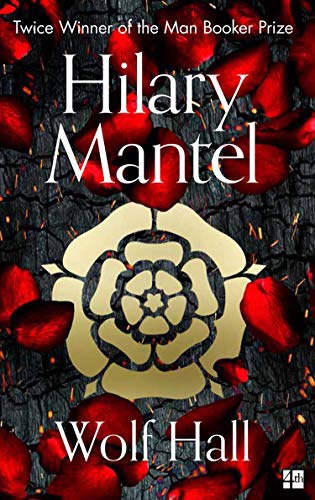
Revisiting fiction has been a bit of a theme this month, as in preparation for the much anticipated release of The Mirror and the Light by Hilary Mantel I joined in my first blogger read along. Embarking on Wolf Hall this month and Bring Up the Bodies next is nicely stoking the fires of excitement . Wolf Hall is as brilliant as I remember, but I do concede that it take a while to get into the rhythm. If you stick with it I promise it is worth it!
I began 2020 with a collection of short stories; Sudden Traveller by Sarah Hall. Hall is an accomplished writer and Queen of the short story. Her collection Madame Zero still looms large in the memory. It was a great start to the month and whetted my appetite for more great short stories.

Luckily I had To the Volcano and other stories -Elleke Boehmer from Myriad Editions waiting patiently for me. Another feast of short stories whose review was an absolute pleasure to write.

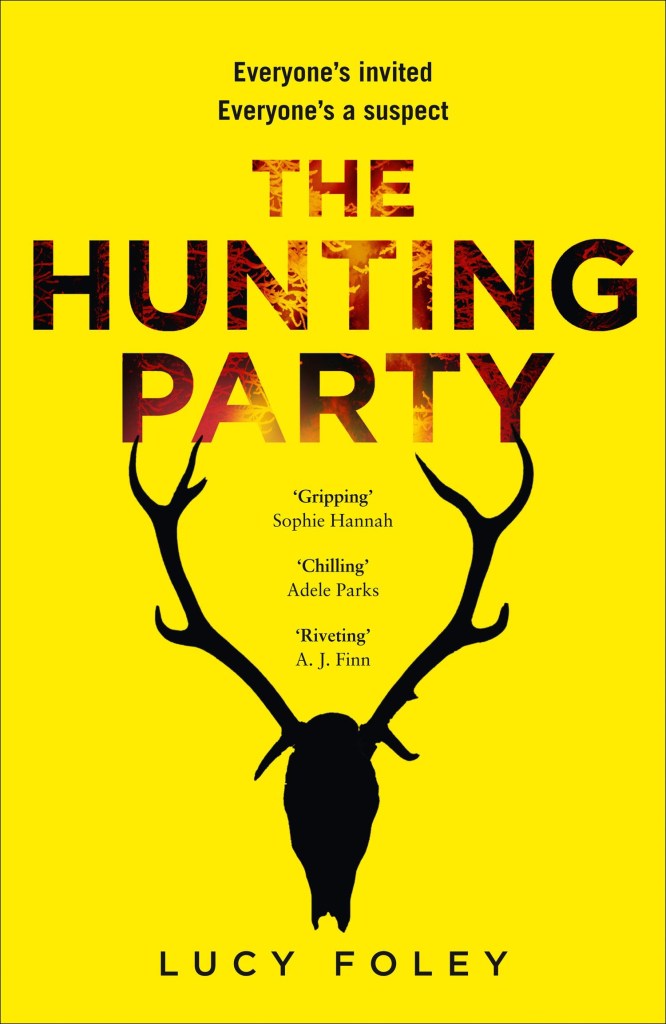
I am very much a physical books girl but I do read on the Kindle from time to time. And this month I read The Hunting Party By Lucy Foley. This novel had been getting loads of attention on Twitter last year and it was chosen as my book club read for January, mainly due to it’s setting, both in place and time. The remote Scottish Highlands at New Year with a murderer on the loose provided a welcome distraction from the rapidly ending Christmas holidays! I read it at the perfect time!
Talking of Christmas, my ‘other half’ did me proud and came up with a bumper stack this year. I have been slowly working my way through, deviating, as you do, alongs paths of proofs and ‘accidental’ book purchases!

Some were devoured and worshipped in that rather strange and chocolate filled time between Christmas and New Year, but this month I have indulged in just a few more.

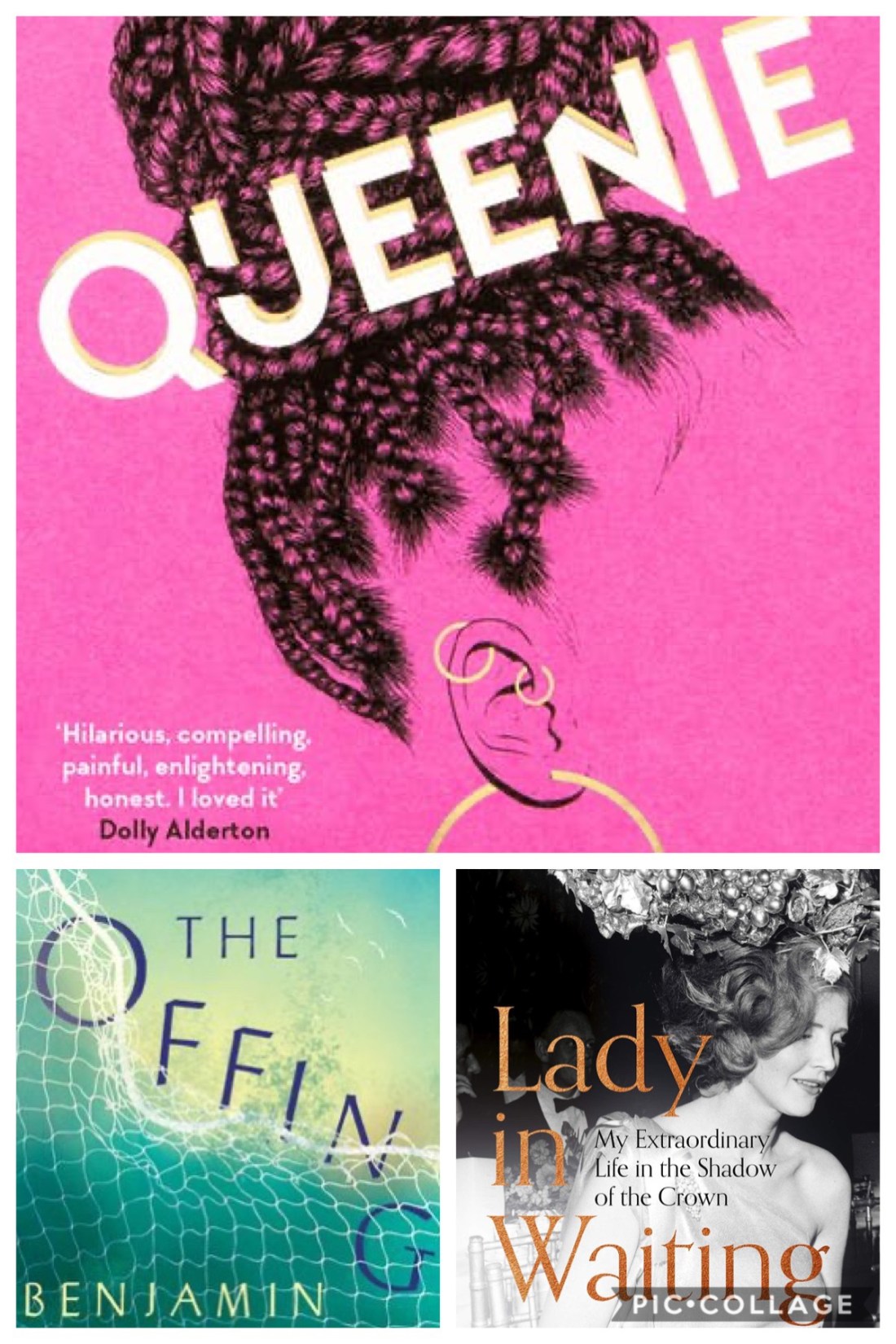
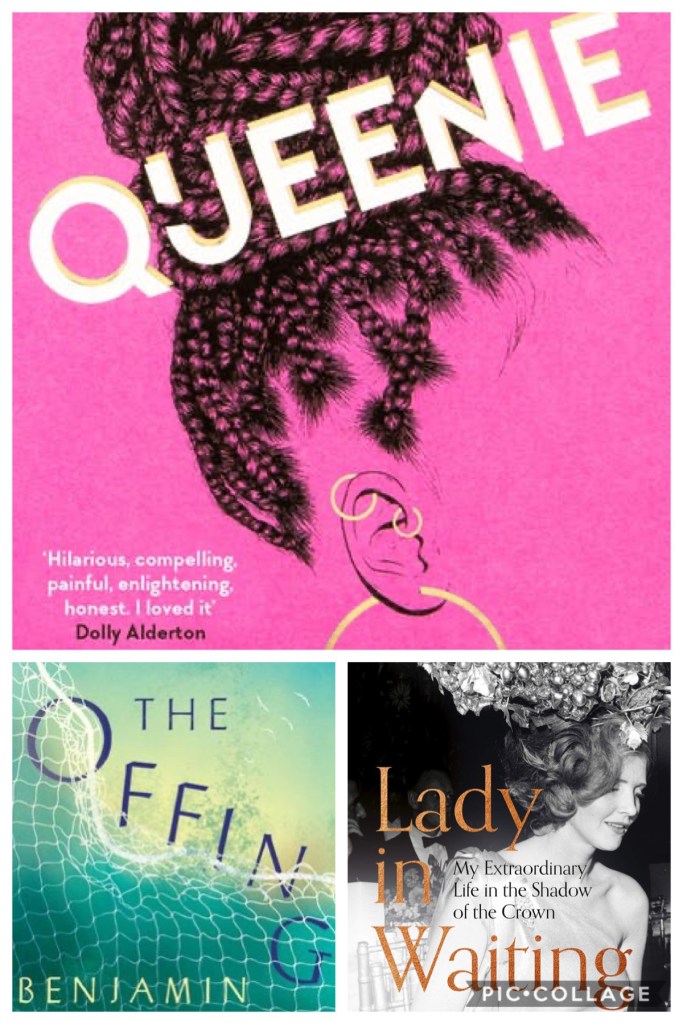
The Offing by Benjamin Myers needs very little introduction. Such a beautiful book, filled with eloquence and stunning descriptions of the natural world, it offered a gentle escape to the East Coast of Yorkshire. A strong story of friendship and support unexpectedly found I honestly loved every word.

Queenie by Candice Carty-Williams was another delight. It is initial tone is quite deceptive. It seems lighthearted, is certainly humorous but as the novel progresses it’s true depth is revealed. Make no mistake, there is a lot going on here. Concentrating on Queenie a young black woman, it embraces her life, her mental health and everything that has affected it. This novel is a must read. And it is also just out in paperback so this is the perfect time to dive in!

Finally from the Christmas stack was my only nonfiction read of the month Lady in Waiting by Anne Glenconner. Lady in Waiting to the late Princess Margaret, it is Anne’s own marriage that provides the most colour in this book. Her husband, Colin Tennant, was flamboyant and charismatic, the brain child behind the exclusive private island of Mustique. He was also mentally ill and prone to tremendous ‘meltdowns’, one of which earned him a lifetime ban from British Airways! Anne has lived a colourful, privileged but also at times tragic live, and I challenge you to read this one without your mouth hanging open!
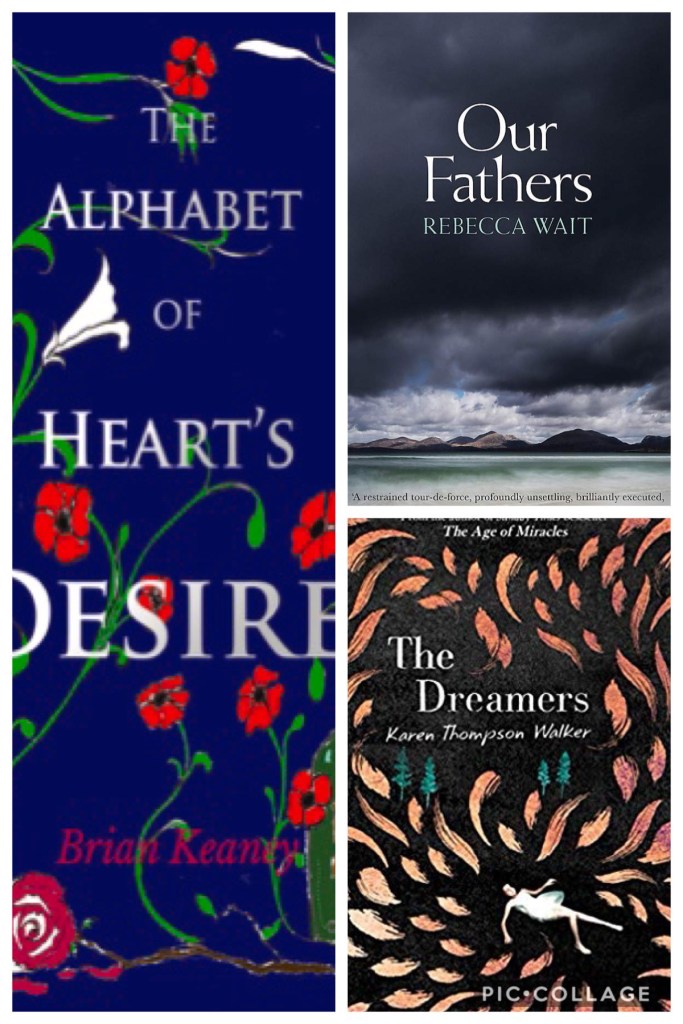
On the whole though, January has definitely been a fiction heavy month. For example I finally embarked on The Dreamers by Karen Thompson Walker. This story, of a strange sleeping sickness that strikes down a Californian town, beginning in the college dorms and leading to the town’s complete isolation, was addictive and unsettling. The feelings were heighten by the fact that no sooner had I closed the book than the Coronavirus outbreak began to be reported.

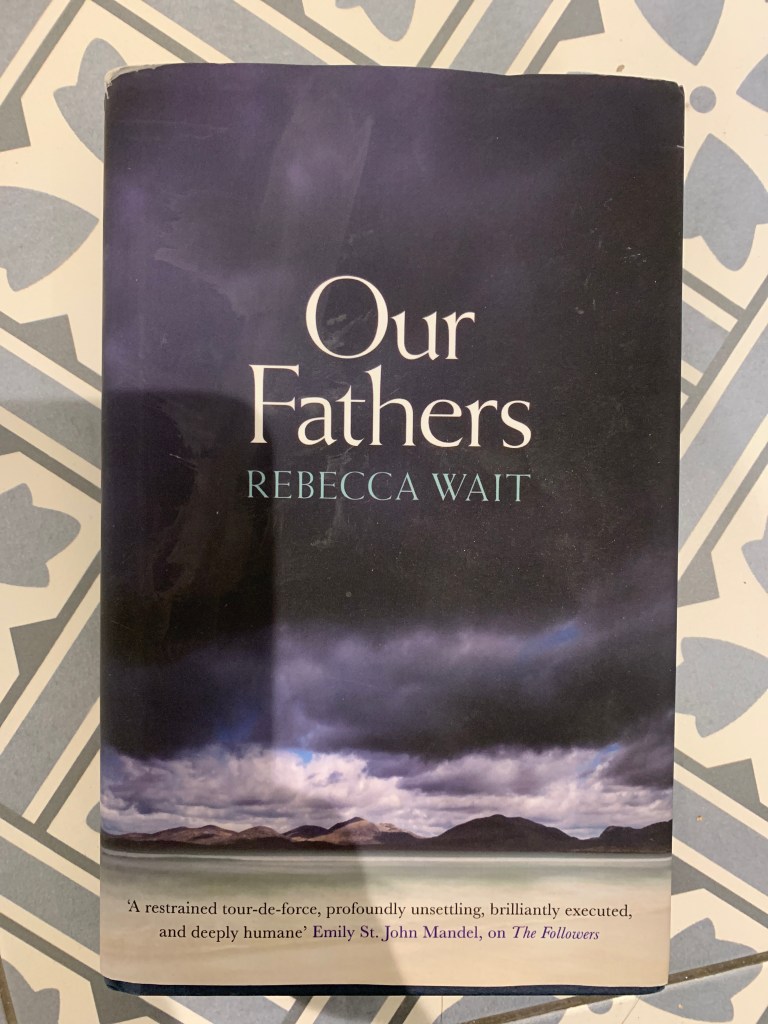
I was lucky enough to read two gifted books this month. Firstly the spectacularly haunting Our Fathers by Rebecca Wait, whose review can be found here, and the historical novel The Alphabet of Heart’s Desire by Brian Kearney from Holland House Books, Instagram mini review can be found here
Reading aside perhaps the most lovely bookish thing to happen this month was my first blogger meet up. With nearly all of us fighting the Great British Rail Network to the last (!), I met up with four lovely bloggers in Manchester. Huge thanks go to Emma, @corkyyorky, Jules, @julesbuddle, Siobhan, @thelitaddict_ and Rebecca, @_forewardbooks, for inviting me along.

Aside from great conversation, food and a teeny bit of wine it was fairly inevitable we were going to land up in a bookshop!

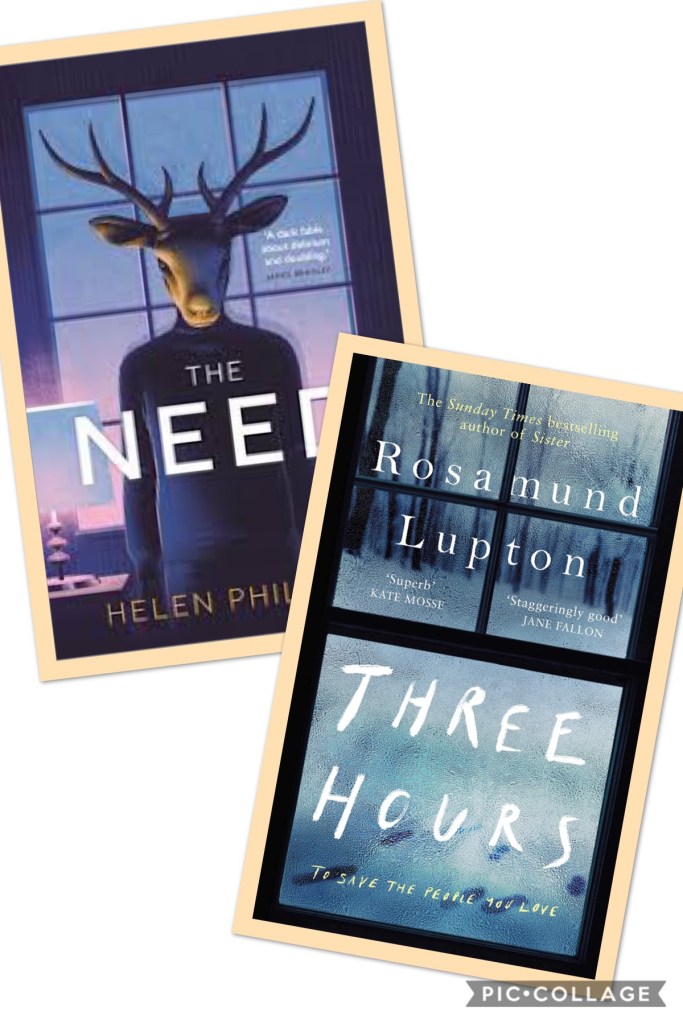
So for the last two reads of the months I have these lovely ladies to thank. It was Emma who told me had to read Three Hours by Rosamund Lupton. She wasn’t wrong! What a book! I am not saying too much as I have a review in the pipeline but I am seriously wondering whether I haven’t already found one of my books of the year! In January, I know!!

I also came away with The Need by Helen Phillips. A really quirky and original read which offers a very honest and sometimes dark commentary on motherhood. I finished it last weekend and I am still thinking about it everyday.
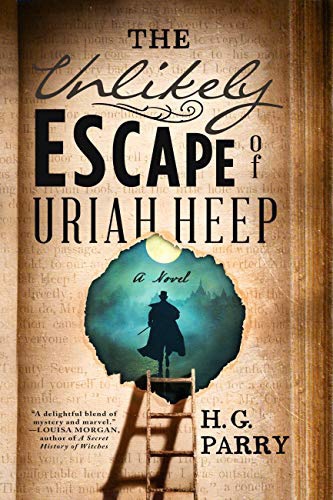
Add in the fact that I have had the pleasure of being involved in two blog tours this month; Payback by R.C Bridgestock and The Unlikely Escape of Uriah Heep by H.G Parry , then this has been a pretty full reading month!

Goodbye January and bring on all the bookish goodies that February has to offer!

Rachel x

P.S. Is it spring yet??
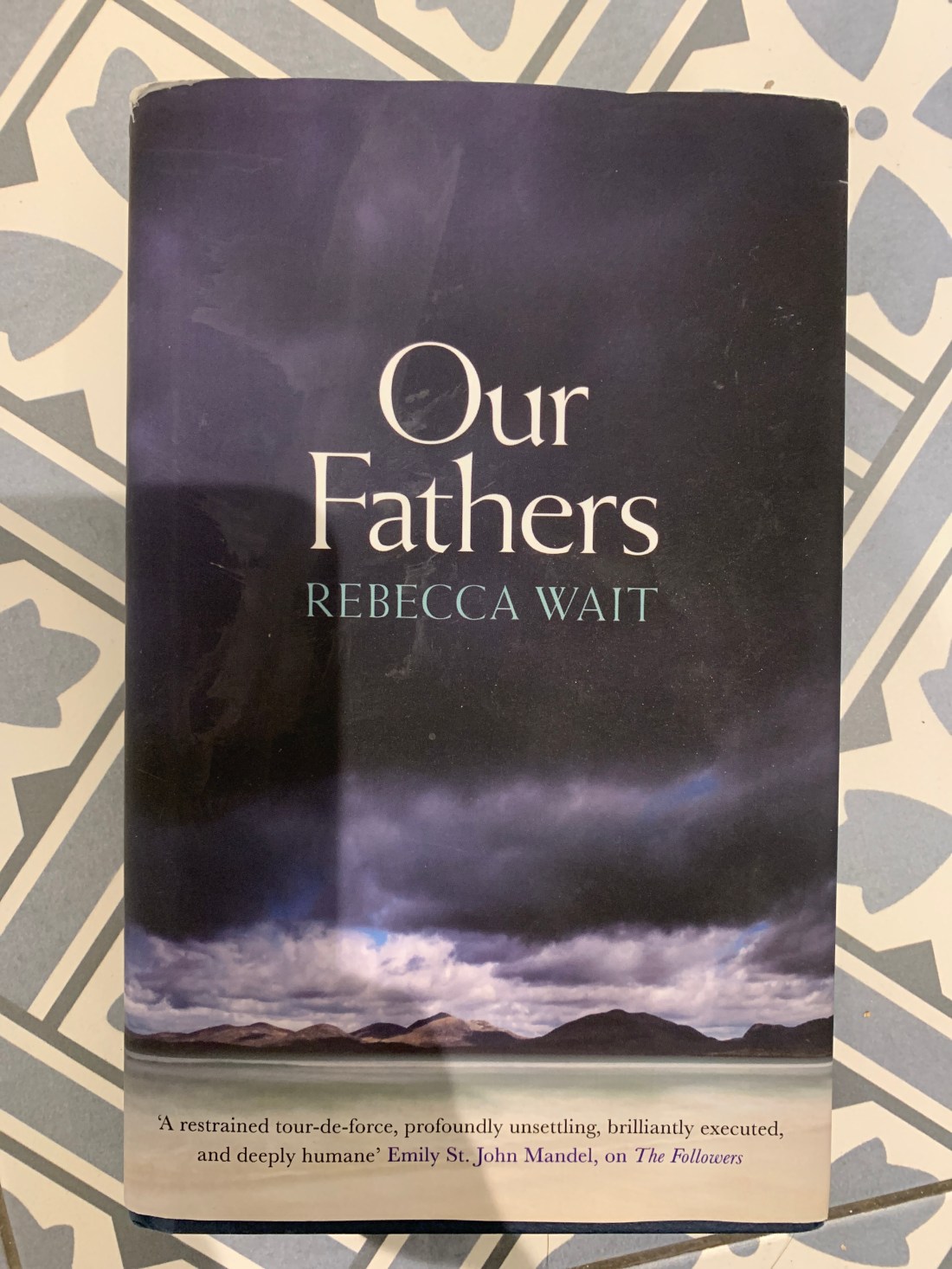
Book Review : Our Fathers by Rebecca Wait

Whenever a book drops through my door I am always, without exception, excited and grateful. The arrival of Our Fathers by Rebecca Wait , however provoked even more excitement than usual. Having seen this on several ‘One to watch lists’, including Siobhan’s, @TheLiteraryAddict, then I had high hopes. I wasn’t disappointed.

The novel centres around the character of Tom, who has returned to the island of his birth, Litta after many years absence.

On this Hebridean island 20 years ago, when Tom was 8 years old, his father killed the rest of his family and then took his own life. Losing his mother, father, brother and baby sister, Tom was the only survivor; found huddled and terrified in his parents wardrobe.

Trying to run from his past, wrapped up in his own guilt and anger Tom has stayed away. But now, unable to lay the past to rest he returns, quite unannounced, to try and piece together what made his father, this seemingly quiet, stable family man commit such a terrible crime.

This is a story which has a truly awful event at it’s heart but the focus is on the before and after of this event. And the cause and effect of the tragedy is beautifully, slowly revealed.

It is the feeling of community that pushes at the sides of this novel. The community that welcomes new comers but equally holds them at arms lengths, unwillingly to disturb a delicate balance between conventionality and morality. It is a community struggling to come to terms with such senseless violence in it’s midst, keen to look for a simple answer to a difficult question. Not quite ready to look beyond the obvious and probe deeper into a families life and a man’s character.

When Tom returns the events, so long buried, but certainly not forgotten, come back to the surface and it is not only Tom who is forced to question what happened and their own part within.

Malcolm, Tom’s uncle, brother of his father, looks back not just to that time but to his own childhood and the way his family relationships developed. Neighbours start to question, albeit internally their own role and responses to the family. And the truth about Tom’s parents relationship is slowly pieced together.

The skill of this book lies in it’s paradox. For a book that has such violence at it’s heart, there is a real air of normality and gentleness about the setting, character and prose. The horror of what has happened is rationalised and cloaked in a conspiratorial silence, all too familiar in cases of domestic violence.

Through skilled and lyrical prose Rebecca Wait builds a powerful portrait of a marriage steeped in control and tension, a warning against silence and inaction. It tackles head on the way abuse, emotional, financial, physical, moves from generation to generation, eroding confidence and becoming blunted and normalised by those in the thick of it and on the fringes.

Given the subject matter, to say that Our Fathers is easy to read sounds glib and inappropriate. And yet it is. But it is east to read not in a light way, but in the sense that story is cohesive. It has an organic flow. It is populated with believable, ultimately flawed characters, brought to life through thoughtful dialogue.

This novel is about much more than one terrible event. It is a representation of the events leading up to and following that event. It shows how shocking events are rarely one off, out of the blue incidents, but that they are the culmination of other more complex and often harder to resolved events and feelings.

This novel focuses on psychology. The psychology of families, of love, control and abuse. And importantly the psychology of community and it’s responses to the actions of individuals within it.

Rachel x

Our Fathers – Rebecca Wait was published on 23rd January by RiverRun

Blog Tour Review: The Unlikely Escape of Uriah Heep By H G Parry

Sometimes a book tour request comes along that is out of my normal reading sphere but nevertheless it speaks to me.

That is exactly what happened when I was given the chance to read and review The Unlikely Escape of Uriah Heep by H.G. Parry , published on 23rd January 2020 by Orbit.

You see I have a bit of a tricky relationship with fantasy books. Although some of my favourite childhood books have a strong grounding in fantasy I haven’t really read much from this genre at all in the last few years. But the premise of this novel really drew me in.

Because the hero of this book can read characters to life! Can you imagine? Settling down with a cuppa and Jane Eyre and finding Mr Rochester snuggled up on the sofa next to you? Or lounging on the beach and finding Moby Dick washed up on the shore?

It is like all those memes and t-shirts you see advertised on Facebook, proclaiming; ‘Reading is my superpower!’ Only this time it’s true and the reality is exciting, the possibilities endless and quite frankly more than a bit terrifying .

The book is narrated by Rob, a normal middle class lawyer, living in Welington, New Zealand, trying to get on with the day job. The trouble is that his brother Charley, an English Professor at the local university, is far from normal.

After a shaky start in life, still born, only drawing his first breath 20 minutes later lying in his grieving mother’s arms, Charley emerges as a truly remarkable child.

Reading Dickens by 4, at Oxford age 13 and a PhD student before he is twenty Dr Charles Sutherland, Charley, is a prodigy. And one with a remarkable gift. His talent for understanding and interpreting literature allows him to ‘read’ characters into the present. It is a powerful skill, but one which his family have always pressed him to keep hidden fearing ridicule and worse, recriminations.

How many times does it take? Just keep your thoughts under control when you read a book! it shouldn’t be so hard!

The Unlikely Escape of Uriah Heep. Pg 8

You see it is the interpretation of character that give characters life and lifts them off the page. All of his life Charley has believed he is the only Summoner, but when literary characters start turning up all over the city then it becomes clear this isn’t true.

Not only are literary characters appearing, sometimes in multiples, there are no less than 5 Mr Darcy’s knocking around (!) but also places. A whole street has sprung up and it is mysteriously growing.

And it seems that, while Charley’s intentions might be benign sometimes even accidental , there is another Summoner at work whose intentions are quite the opposite. This mysterious creature makes it clear they are ready for war and they have over a thousand years of literature at their disposal from which to create an army, adding a whole new meaning to ‘Words as weapons’!

Suddenly Charley’s hidden ability is needed to save the city. Torn between family loyalty and his love of the characters he has unwittingly brought into the world, Charley is fighting to maintain control.

This novel is certainly a wonderful, jolting fantasy ride but at it’s heart there are many lessons to be learnt. Not least this book has much to say about the nature of family and what constitutes the ties that bind. It’s about the people we choose to surround ourselves with and the sacrifices we are prepared to make for those people.

This is a book written by a book lover, for book lovers everywhere. It is bursting at the seams with everyone’s favourite characters. I might have let out a little involuntary scream when Heathcliff appeared and the inclusion of a leather clad White Witch astride a Silver Harley Davidson was just sublime!

But most of all this book is fun! It’s like a breath of fresh literary air and there are no limits to what can happen. Sit back enjoy and let your imagination run wild !

Rachel x

And there is more…

For other great reviews and reactions to this unique book, check out the blog tour poster below!

Blog Tour Review: Payback by R.C. Bridgestock

Sometimes an offer comes your way and there are one or two words in the inquiry email that grab you immediately.

This is what happened when Dome Press asked me if I would like to be involved in the Blog Tour for Payback.

And those two words were Happy Valley. You see the pen writing duo that created Payback, Carol and Bob Bridgestock, were previously storyline consultants for the gripping TV series, starring Sarah Lancashire and also the equally wonderful Scott and Bailey. Just reading those two words and I was pretty sure I would be in for a damn good story.

And I wasn’t disappointed!

Payback is the first in a brand new series and introduces the character of Charley Mann. Charley is a ambitious and accomplished police officer. She left her beloved Yorkshire to work in the Met, where she has been fast tracked. Returning now to her home town, she is about to take on the role of DI, the first female officer to rise to this rank in the area.

Coming home is bittersweet. Her love for the locality and it’s people is tainted by previous relationships gone sour, both in the work place and her personal life.

Her former mentor, DCI Roper is one such person. Experience has taken the scales from Charley’s eyes, calling into question everything he stands for and certainly his behaviour in the job.

Closer to home Charley is struggling to deal with the attentions of her childhood sweetheart and ex-boyfriend Danny Ray. Now a local reporter, he seems to be popping up all over the complex murder investigation that she finds herself immediately caught up in.

The murders are fascinating. Brutal, with complex crime scenes and seemingly obvious suspects who don’t just fit the profile. It is here that the experience of the writing team is apparent. The procedural writing is more than plausible, it is authentic and gripping, challenging both character and reader to the end.

Charley is a strong independent woman but she isn’t without her ghosts. The balance of power with her ex partner Danny is an interesting power dynamic and the portrayal of control and it’s misuse in a relationship is fascinating and dark.

Charley is a character on the rise professionally but her personal life is complicated and her methods of escape and release are unorthodox and sometime dangerous. At times she is living on the edge, and risks her personal and professional life colliding.

In addition to strong characters and storylines this novel has a fantastic sense of place. The Yorkshire town and it’s surrounding countryside are affectionately, but accurately portrayed. I particularly enjoyed how local folklore peppered the narrative giving the action a truly grounded feel.

If you are looking for a well written and well rounded crime novel, with just the right amount of bite and heart then look no further.

Enjoy!

Rachel x

And there is more…

For other reactions and reviews to Payback then check out the rest of the blog tour …

Book Review : To The Volcano and Other Stories by – Elleke Boehmer

I finished last year with an unexpected short story collection review and looks like I am starting 2020 the same way.

Here is the point in the blog where I have to hold my hands high in apology to the good people at Myriad Editions.

Because last summer I remember requesting a copy of To The Volcano by Elleke Boehmer and then life got in the way. It has sat on the book trolley, shamefully neglected…until yesterday …

Yesterday I opened it up, read a page… which turned into a whole story…which turned into another story…and…

You get the idea! Long story short, I finished it in a day! So now is the time to review.

When I read a collection of short stories I tend to look for a theme, something that binds the whole together, without losing the individuality of each tale. It’s a tall order I know, but To The Volcano did not disappoint.

There isn’t one over riding theme but many that run through the collection. Firstly, this is a selection with a international and cosmopolitan feel. Settings range from a University town in England, to South African, to Argentina, to Paris. And beyond. In addition characters are constantly travelling, on the move looking for answers, trying to fulfil dreams and escape.

And yet for all the feelings of excitement and discovery there are equal and, sometimes, overwhelming feelings of fear, displacement, unease and straightforward homesickness.

Take for example Luanda, the accomplished ‘African’ student who featured in The child in the photograph. When we meet her she has fulfilled her dream of attending a world renowned western university only to realise that the key to her happiness and fulfilment lies back where she first began.

Similarly Lise ( South, North) has travelled half way around the world only to discover the Paris she fell in love through the pages of Zola and Balzac isn’t the reality of modern day.

There is an underlying and ongoing commentary here about the fact that all destinations come with preconceived ideas and expectations. In the title story, To The Volcano, a group of university employees and students go on a field trip to an elusive and extinct volcano. Each visitor has very different experience of the same place, leaving us questioning is the destination itself really shape shifting or is it merely a mirror for the emotions of its visitors?

For this collection isn’t just about geographical travel, it is very much concerned with our journey through life, how we interact with others and how those relationships change through our daily experiences and expectations.

It is a collection about fine lines, and how they shift constantly throughout our lives. It is about the appropriateness of relationships, love/ hate (Powerlifting), concern/ control, swimming/ drowning (Synthetic Orange), youth/ age (The Biographer and The Wife).

It delivers thoughts on how we create relationships and what we take away from them. Boehmer continually poses that age old question; Do we take and give in equal measure?

There are 12 intelligent and individual stories to discover in this collection. Unsurprisingly I have my favourites, which I am loathe to disclose, because I feel the take home message from To the volcano and other stories is that life is an individual journey and your favourites are pretty much guaranteed not to be mine.

Signing off with a huge thank you to Myriad Editions and Elleke Boehmer for gifting me this copy for review.

Rachel x

To The Volcano and other stories can be purchased by clicking here

Blog Tour Review – The Man Who Saw Everything – Deborah Levy

Deborah Levy is a writer unlike no other.

This strikes me, even as I write it, as a sentence that feels over used and some what stale. But that doesn’t stop it from being true.

There are so many authors out there that I admire but Levy’s work is always immediately identifiable as hers. Her work is consistently insightful, always complex and raw, and always magnificent.

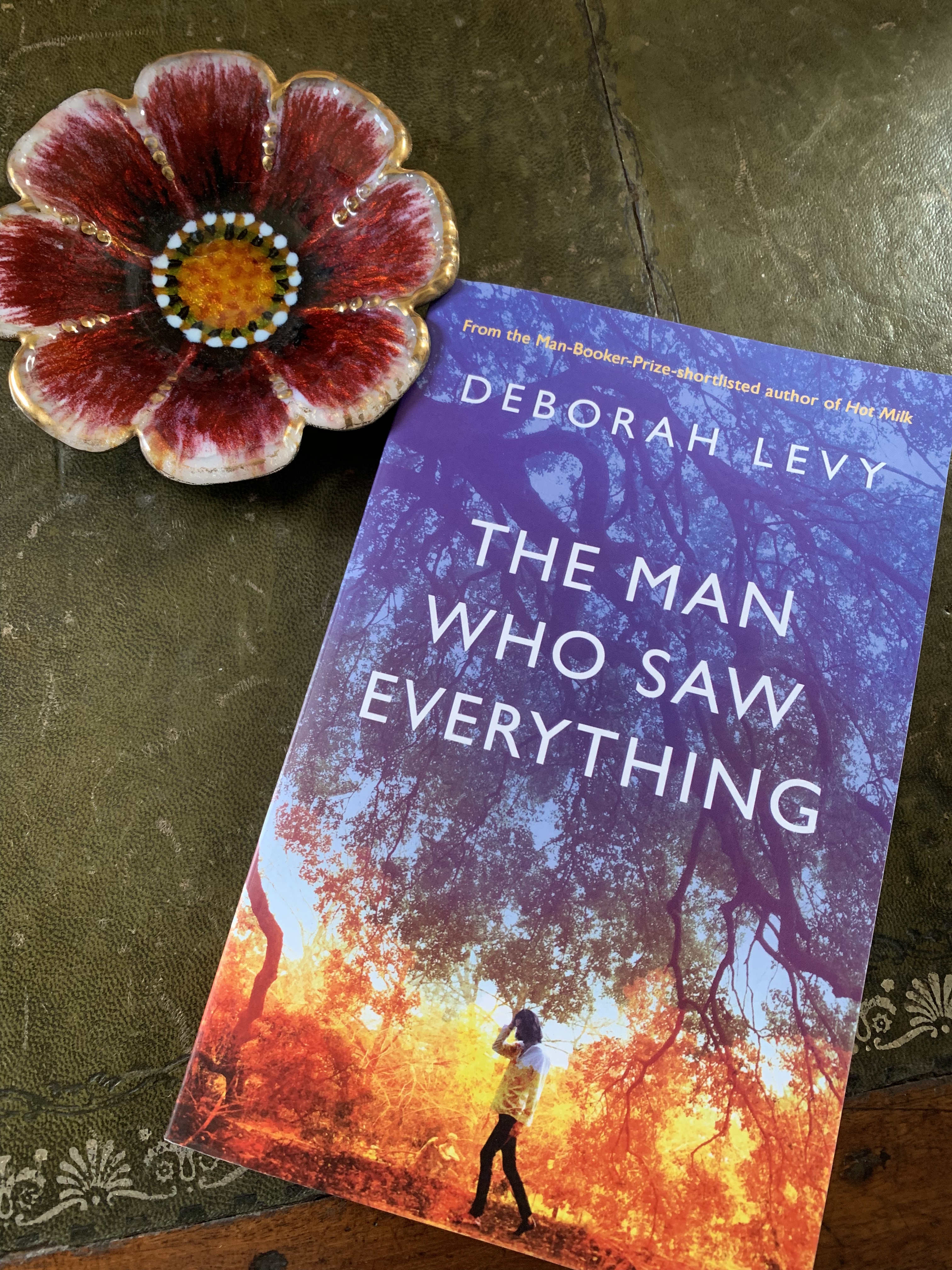
I am thrilled to be part of the blog tour for her third Man Booker long listed novel, The Man Who Saw Everything.

The novel centres on Saul Alder, a young historian and opens in 1988. Saul is knocked over on the famous Abbey Road crossing, and despite a rather confusing encounter with the driver who hits him, seems physically unharmed. Immediately after the accident he visits his girlfriend, Jennifer Moreau, a talented American art student and fiesty independent women, who has imposed clear rules on their relationship.

This evening is a crossroads in their relationship. Saul is about to embark on a research trip to the German Democratic Republic (GDR), Jennifer is finishing her studies and moving on. Saul proposes marriage, Jennifer ends the relationship. The theme of misremembering, misinterpretation and conflict begins, and we get our first glimpse of the nature of Saul Alder.

For Levy has created a character that is intelligent, beautiful and articulate. Having lost his mother at an early age Saul seems emotionally tied to the past. At odds with his working class father and bully of a brother, refusing to remove his mothers pearls, Saul Alder is self absorbed, often selfish, but certainly not self aware. A man with an incredible eye for detail in the world around him, he is woefully lacking in his understanding of his own character and behaviour.

As his relationship with Jennifer ends Saul travels to the GDP. He is assigned a translator, Walter Muller, with whom he begins a relationship, one which comes to dominate his life despite it’s breivity. He also becomes involved with Walter’s sister Luna, a young woman looking for her key to the west.

The second half of the book takes place in 2016. Saul has again been struck by a car, again on the infamous Abbey Road crossing. This time he is seriously injured and the second half of the book is an account of his time in hospital. A time where the threads of his life come together and Saul begins to face the man he is.

Throughout the novel there runs an overwhelming sense of history; personal history and world history, particulary that of Europe. It is not a linear presentation, rather it is fragmented, appearing in snapshots, interpreted and misrembered by individual characters each adding their own version of events.

Levy continually plays with the concept of time. There is a fractured and fragmented feel to the novel as elements from each part of Saul’s life appear in the wrong place, at the wrong time. Personalities from the past appear in the future and vice versa, creating a running commentary on the complexity of what makes a person and what defines our experiences and choices. There is an inflated sense of deja vu as the echoes of the past affect the future and back again.

Saul feels like a conduit within the novel, a way of drawing together the past, the present and the future. A feeling embodied by Luna, when she says…

But you must.” she said, firmly. “You are history”

Pg 89

Continually the lines of time are blurred. Whilst in the GDP Saul is able to give Luna an accurate prediction about the fall of the Berlin Wall, bringing the future to the present. Equally we feel that the grief he holds, literally around his neck, for the loss of his mother, is what drives Saul to his study of German policital history. Again Levy is playing with and breaking through the barriers of time to create the sense of a novel seeped in history but unconstrained by it.

Throughout the novel there is a sense of haunting. The image of spectres appear again and again, particularly as Saul is hospitalised after his second accident. Levy points out that events in our lives continue to contribute to and define us as we move forwards. Similarly the motif of wolves, dogs and predators stalk the narrative, in the way that his grief for his mother and his guilt surrounding his relationship with Walter stalk Saul’s own life.

Yet Saul is the ultimate unreliable narrator. Taking into account the moving and fractured time frames, his own lack of self awareness and his two accidents, there is a continual sense of story and an author shaping and rediscovering themselves. At times this feels very insular and persoanl to Saul’s story, at other times this feels very much like a wider metaphor for the historial and polictical times we currently find ourselves in.

For this is a novel steeped in the history of Europe. There are continual references to various European countries and influences, woven skillfully into the narrative. The history of Europe and it’ s division and subsequent reunification through the fall of the GDR is central to the novel. It doesn’t feel coindicidental that Saul’s second accident is firmly in the time frame of the EU referendum result. There is a feeling that whatever our future relationship with Europe, we are still bound to it through the past and the present. Nothing is as linear as we would like to believe.

It feels so trite and unimaginative to call this novel complex and orginal. But it truly is. Every review I have read has come up with a different perspective and focus. For it is a novel that lends it’s self to interpretation and discussion. There is so much more to this work than I could ever hope to include in these short paragraphs. It is a work to be read debated and then reread. And I guarantee that much like the narrative structure adopted by Levy your perception will shift and you will find new angles, new motifs and new meanings upon each reading. I have read this book twice in 5 days and each time I have taken something different away from it.

The Man Who Saw Everything is an incredible book. There is no doubt it is a novel for our time; it is a novel for all time. And I am predicting a third Man Booker short listed book for Deborah Levy.

Book Review : The Wayward Girls By Amanda Mason

I am pretty sure that in the few short months that I have been blogging I have managed to mention my innate love of ghost stories, at least once or twice!

So when The Wayward Girls by Amanda Mason, due for release on 5th September hit my radar I suspected I was in for a treat.

The Wayward Girls by Amanda Mason

Set in the long hot summer of 1976 this is the story of a family living in a remote farmhouse whose world is turned upside down by strange and quite frankly terrifying happenings. Excited yet ?

Well you should be. Because if like me you like to be just a little bit scared by your reading matter this is one not to be missed…

When the Corvino family move to Iron Sike Farm it is in search of an alternative and simpler life. Cathy, a rather harassed Earth mother and Joe a struggling artist arrive with their five children Dante, Lucia, Bianca, Florian and Antonella in the spring. But by early summer the cracks are starting to show.

Dan and Bee, the elder children resent being ripped away from the city and their friends. Loo is struggling with the new regime of home education and home cooking. Cathy is drowning in housework and child care and Joe’s creative muse has left him.

When Joe disappears, allegedly ‘working away’ the frustration and boredom on all sides of the family reaches fever pitch, suddenly to be replaced by something much darker.

The haunting began quietly once the Corvino family had settled into their new home; the girls heard it first, the knocking inside the walls.

Extract from A Haunting at Iron Sike Farm by Simon Leigh

(Chapter 1 – Now)

Beginning with unexplained noises, missing property and uneasy feelings, events at the farm rapidly lead Cathy to seek outside help. When local press photographer Isobel gets wind of things it isn’t long before the farm becomes the focus of a team of paranormal investigators. Experienced Professor Michael Warren and rookie Simon Leigh are fascinated and excited by the unexplained events, all of which seem to be centred around the two girls Bee and Loo.

As the summer heat intensifies events soon spiral out of control, changing the lives of those involved forever.

The telling of the story divided across two time frames. As well as concentrating on the summer of 1976 we join the grown up Loo. Now Lucy, she has spent the intervening years trying to put the events at the farm behind her. But as her Cathy begins to decline the past returns to haunt both of them. And when Simon’s daughter Nina makes contact, determined to pick up her late father’s investigation, Lucy finds herself back at the farm and is forced to confront a past she hoped was firmly behind her. Will the new teams findings shed further light on what resides at the farm? It are somethings just best left alone?

All the hallmarks of a great ghost story are firmly stamped on this novel. From the moment I picked it up I was drawn in and held in it’s grasp. Right from the start there is an an air of inevitability and urgency, an uneasiness with past events not yet settled.

The structure of alternating time frames is used to create the palpable feeling of tension within the novel. As we move from the past to present and back again, the story seems to builds with a life of it’s own. Each event and revelation slowly adds another layer of anticipation and pulling the reader further in.

The girls Loo and Bee are undoubtedly the focus of the seemingly paranormal activity. They are girls, on the edge of womenhood, who suddenly find themselves the centre of all kinds of attention. Michael is convinced that the girls have attracted a poltergeist, their teenage energy acting a a conduit.

Yet continually the author allows doubt to creep into the narrative. The girls are clearly unhappy. Bee especially is seeking adult attention, and both girls are drawn to the young and attractive Simon, possibly seeking a father figure after Joe’s departure. Simon becomes a source of tension between the two, revealing the strength of feelings of Bee in particular.

And if Bee is at times reckless in her behaviour, she isn’t the only . Caught up in the unreality of the situation there is a feeling that all normal rules and conventions have been forgotten or at least disregarded. It is as if a spell has been cast over the farm, a place where adults are pushing the boundaries as they seek answers, playing a dangerous game and overlooking the risks.

A long unbroken summer is not the traditional weather to accompany an ghost story. There are none of the swirling fogs or crashing storms of other gothic tales. And yet the juxtaposition between light and dark works. The unrelenting almost mythical heat reflects the air of unreality created by events on the farm. It is as if real life is suspended and people have lost touch with reality.

And who is in control? Who can be trusted in this place? Indeed who can we the reader trust in this tale?

Right to the last page the sense of unease continues. As a reader we swing between time frames and view points continually questioning and reassessing. This may sound like a cliche but this one really will keep you on your toes until the very last page.

The Wayward Girls is an accomplished and complex novel, and as a debut it is a stunner. Look out for this one when it is published on 5th September by Zaffre Books.

I can’t wait to see what Amanda Mason does next…

ManBooker Review #3 : 10 minutes 38 seconds in this Strange World by Elif Shafak

This is a truly beautiful book.

Obviously visually with it’s stunning cover, shades of blue and gold that complement each other so perfectly.

But the words, the words within are truly, truly beautiful. This is a story told and imagined through the senses. Through taste, touch, smell. Through sound and sight, Istanbul and it’s inhabitants are brought to life.

At the simplest of levels this is the story of Leila, a prostitute found dead in a dumpster in Istanbul, discovered and then robbed by youths high on glue. A story with such an ugly beginning is in fact breathtaking in it’s beauty.

The story of Leila’s life is told as her brain begins to close down, minute by minute, sense by sense.

And Leila’s life is unexpected, intertwined with the people she meets and importantly the friends she makes. Five friends, all with different stories, backgrounds and ethnicity, that come together in the cultural melting pot that is Istanbul.

All five of Tequila Leila’s friends are outcasts in one shape or form.

Nostalgia Nalan, once Osman, a brave transgender woman who ran from her farming family in Anatolia on her wedding night.

Sabotage Sinan, Lelia’s oldest friend, son of a progressive female pharmacist, now trapped in a loveless marriage, forced to hide his friendships.

Jameelah, Somalian born to Muslim father and Christian mother, destroyed by her mother’s death, trafficked to Istanbul and prostitution.

Zaynab122, born in Lebanon into a Sunni family. A family so intermarried that dwarfism is common, hence the 122. Making her way to Istanbul, she finds herself cleaning the brothel where Lelia works.

Hollywood Humerya, cat rescuer and nightclub singer, at home in Istanbul after running from Mesopotamia and an enforced, abusive marriage.

These friendships are the core and the heart of our story. They are the core and the heart of Lelia’s life. Rejected by her own family Lelia’s support and sustenance comes from this diverse group, a complexity which is symbolic and reflective of the city around them.

This is story of true friendship, the friendship that springs from adversity and a meeting of souls, friendships that move beyond accepted definition and become akin to family.

…there were two kinds of families in this world: relatives formed the blood family; and friends, the water family…

…the water family, this was formed much later in life, and was to a large extent of your own making. While it was true that nothing could take the place of a loving, happy blood family, in the absence of one, a good water family could wash away the hurt and pain collected inside like black soot…

Her ‘water family’ are those people that Leila’s can share her truth with, that support her throughout her darkest moments and crucially whom her thoughts turn to in death as her mind slowly, over the course of 10 minutes, 38 seconds, shuts down.

The story of friendship is wrapped in a unique structure. Beginning with a chapter entitled The End we see Lelia’s death. Then follows three parts, The Mind, The Body, The Soul.

This novel is not linear, the story of Lelia’s life twists and turns just like the city that nurtures it. Yet it is the collection and formation of these unique friendships that are the glue that holds it all together.

Istanbul is portrayed as a feast for the senses, the span of the story and the diversity of the characters provides a tangible sense of the political, religious and historical turmoil and tensions which has created and at times almost destroyed this city. A city on a boundary, where East quite literally meets West, with all the complexities that brings.

Here we see the traditional and the modern fighting to co-exist. Sometimes rubbing alongside each other in a disordered and disjointed way. Sometimes one breaking the other beyond repair.

Story after story with in this novel present us with the expectations of family, of parents demanding conformity and tradition and of children torn. Torn between love, loyalty and the need to be true to themselves.

This is a story of what happens when your desires and your experiences don’t fit your preordained path. And how you find a place in the world when your world has rejected you.

And time and again in this generational, cultural, political battle it is women who are the casualties.

Women who are forced into marriages that abusive and filled with constrain . Women who are forced to give up their children, be it at birth or later in the name of family honour. Women who give up their bodies to survive, to serve the needs of men. Women who pay for men’s mistakes when political will changes and religion closes down a household and it’s freedoms.

What better way of commenting on the treatment of women by making a prostitute the focus and the protagonist of this story? By challenging each reader to look beyond a tragic and inauspicious start and to use that great leveller, Death, to revel this women’s history. To share her passions, her past, her tragedies and triumphs. To show us that we need to look beyond the label and the preconceptions, that in built sense of inevitability to discover the real women beneath. To see the brave women escaping one life and trying to make their own realities.

For Death is our storyteller here. It is the one inescapable factor in life and is presented throughout with a gentle but biting humour.

It is the rituals surrounding death that bring Lelia and her ‘water family’ together for one final time. The last section of the book is possibly one of the greatest testaments to friendship I have ever encountered in literature. It challenges the idea that there is one way to deal with a death, bringing together many rituals, creating the idea that departure should be as unique as each life lived.

A book of sincerity and complexity, of beauty, alongside great sorrow, Man Booker Judges if you are listening, this one deserves the Short List.

Rachel x

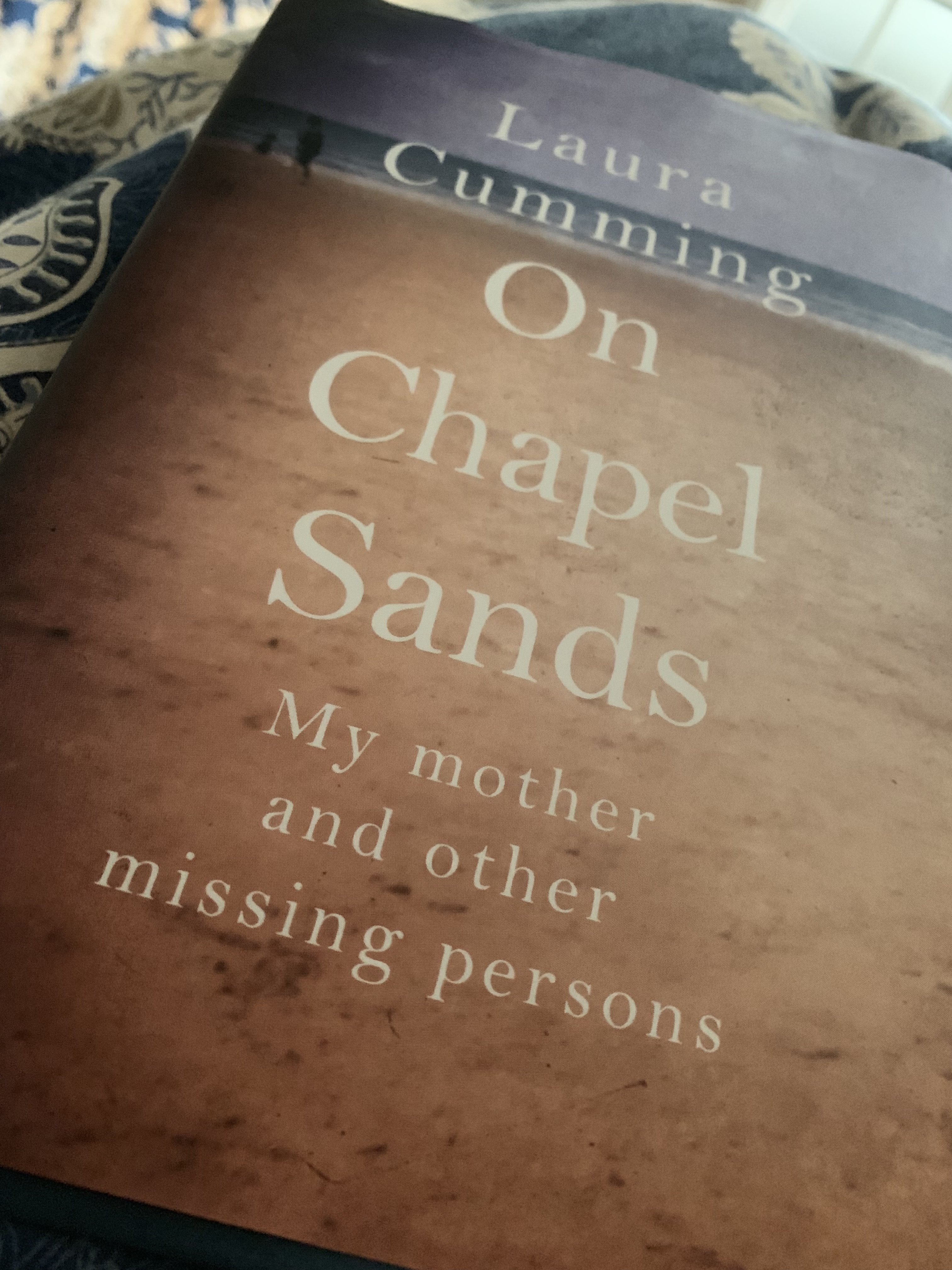
Book Review: On Chapel Sands by Laura Cumming

I seem to be continuing my entirely unplanned literary trip back to the landscape of my youth. This time we are on the Lincolnshire the coast Chapel St Leonard’s in fact, just along the way from Skegness and all it’s seaside paraphernalia.

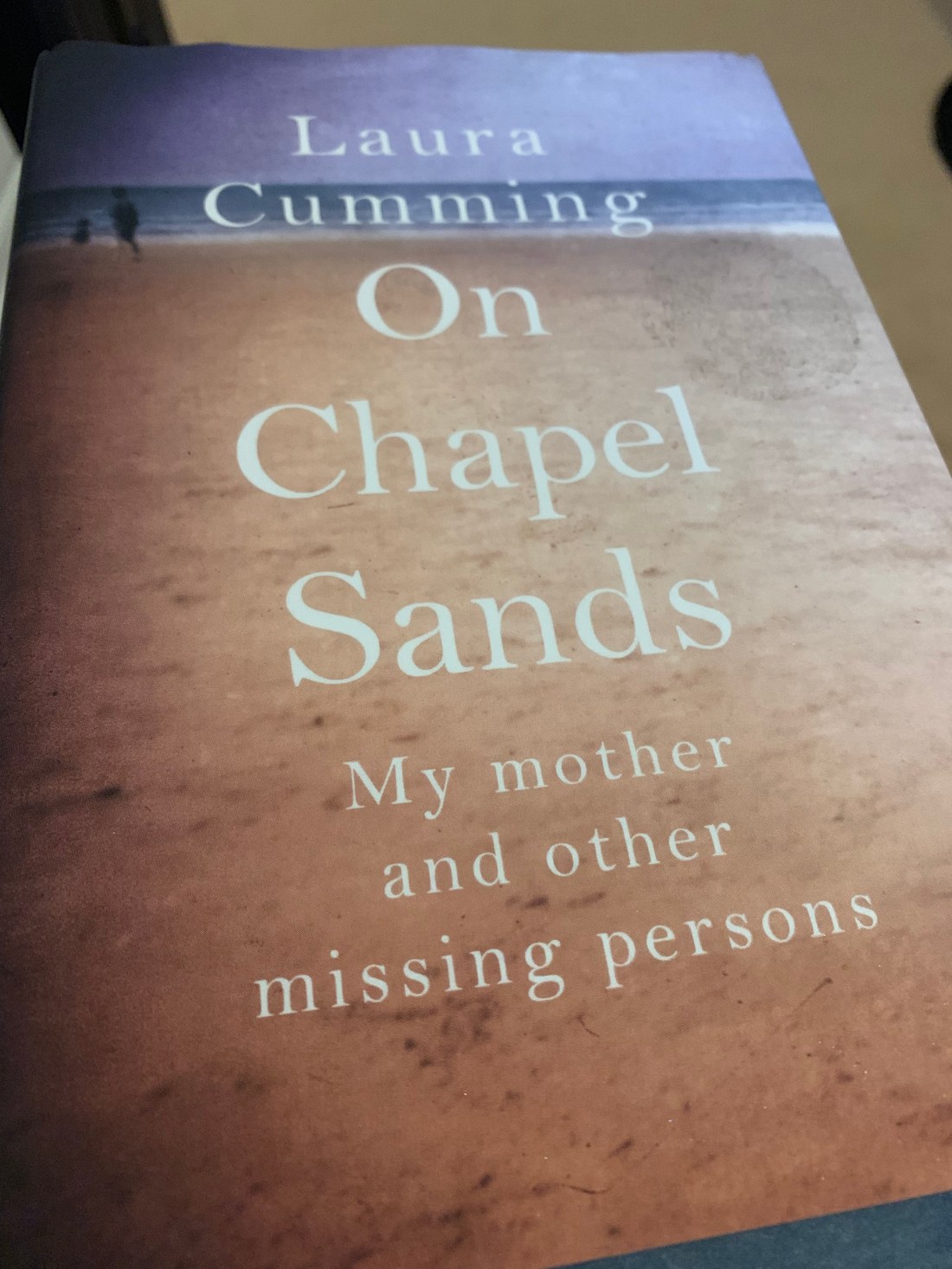
It is the setting of the beautifully crafted On Chapel Sands by Laura Cumming, published by Chatto and Windus. It is the telling of a family history, moreover it is the telling of a family mystery, one that has remained in the shadows for many years.

Before I start I need to say that I nearly didn’t review this book.

Not because I didn’t enjoy it. I was utterly entranced. The story captivated me in that special way that only true stories can, as I listened to my constant inner voice repeating ‘My God, this actually happened…’

I hesitated about reviewing because I was worried that I would give something away.

For this is a story that needs to discovered. Piece by piece, layer by layer, just as the author and her family have uncovered, assessed and redefined their truth. I knew I needed to tread lightly.

So in terms of ‘plot’, ( and using the word plot feels wrong when you are dealing with someone’s life !) I will give you the merest hint. Just enough to whet your appetite, but trust me this is a feast waiting to be discovered.

The story begins in 1929, a young girl Betty is playing in the warm autumn sunshine on Chapel beach. She is 3 years old. Her mother, Veda, is sitting near by. Her father, George, a travelling salesman is away from home.

In the blink of eye she is gone.

Vanished.

Betty is missing for 5 days. She is finally discovered unharmed, dressed in new clothes, in a house a few miles away.

Restored to her family, Betty’s life continues and, although the ‘kidnap’ is common knowledge within the tight knit community, it is never discussed.

But the reasons behind it and the effects it has on this family will define not only this but generations to come.

And so begins the telling of a complex tale. A tale that is told with remarkable skill and originality. At no point does the reader feel lost in the tangle of truths. There is a structure and fluidity to the retelling which drives the tale onwards, not withstanding it’s many twists, turns, even dead ends that appear along the way.

This is a unique family story and it needs to be told in a unique way. Laura Cumming harnesses all her skills as an art critic, systematically analysing family photographs taken through out her mother’s childhood, almost exclusively by her Grandfather George.

These photographs are the chronicle of her family, and Cumming assesses each one, looking to discover the subject’s intent and their emotion. Timelines, settings, clothing and scribbled captions are all scrutinised to build a picture of her mother; her childhood, her beginnings and the very essence of identity.

Throughout there is that familiar feeling of trying to make sense of the past. The way we all grasp at the scraps others have left behind. The way we try to fill in the gaps with ancestors thoughts, feelings and motivations. Cumming and her mother are trying to join the dots on a masterpiece, and it is a process that will take the whole of the book.

Art is a constant ribbon running through the fabric of these words. Beyond the carefully crafted photographs of George, both Laura’s parents were artists, she herself has made her life in artistic circles. Art in this book is a mirror and sometimes a magnifying glass, offering escape, clarity and a whole new perspective on an intriguing and sometimes painful puzzle.

Cumming’s voice throughout is one of intelligence and integrity. Her love for her mother seeps from the pages and yet she allows others in this story their voice. One of the most poignant elements of her work is the fact that the perspective and viewpoints we encounter are not static. In true art critic style we are encouraged to throw off our preconceptions and look at this from all angles.

And the story and it’s conclusion are all the better for this.

I have no doubt that this book will stay me for a long time. For anyone who has ever looked back at their own family story and wished for a second of clarity, for anyone who has unanswered questions, quite possibly lost to the mists of time, this book will hold a special charm.

See you on the sands.

Rachel.

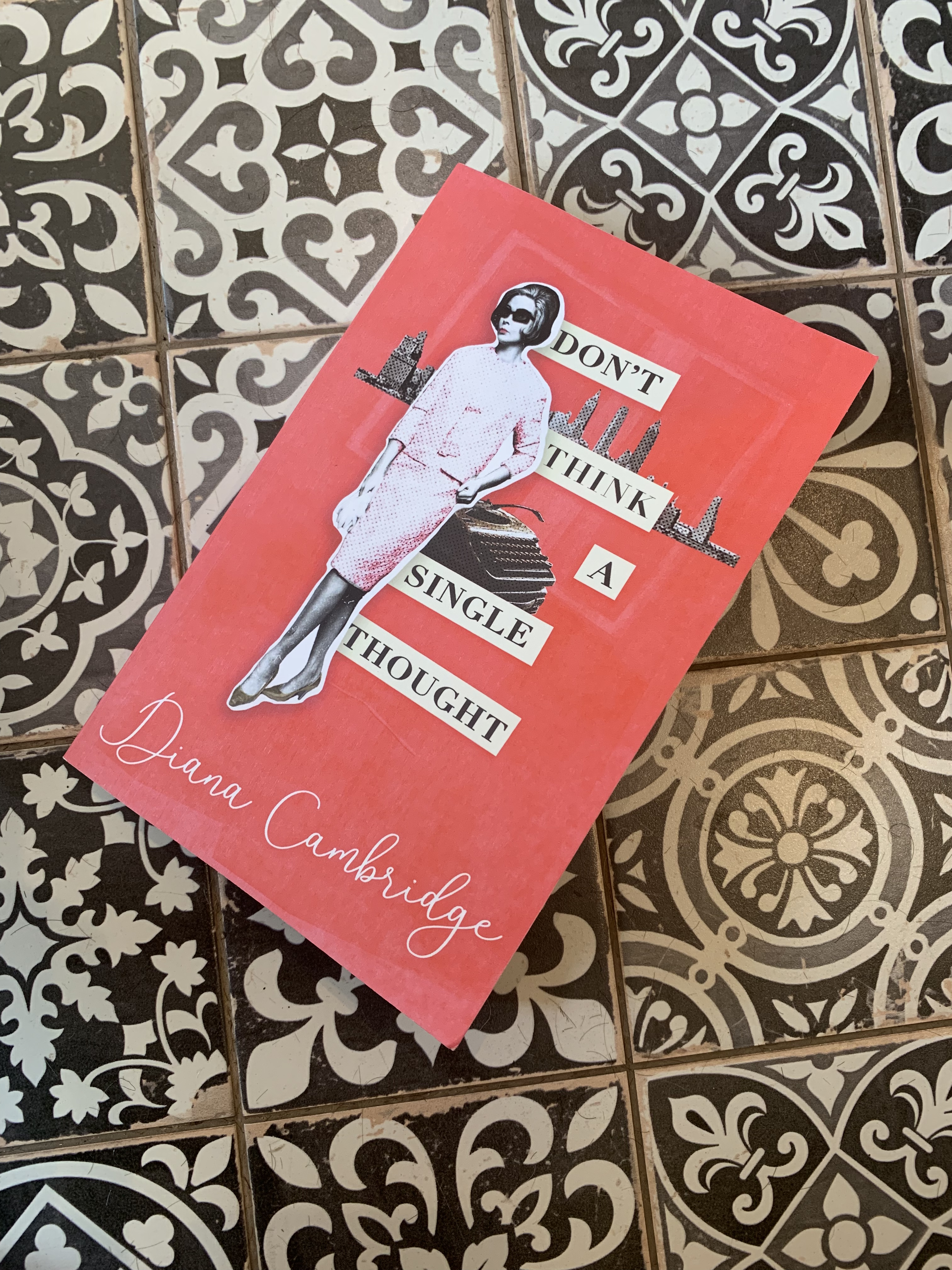
Book Review: Don’t Think a Single Thought by Diana Cambridge

So one of the most exciting and, honestly, most unexpected bonuses of blogging about books is the chance to discover and engage with some fabulous and very talented independent publishers.

One such publisher is Louise Walters of Louise Walters Books. Based in Oxford and founded in 2017 Louise was one of the first publishers to take a chance on a newbie blogger – a.k.a moi(!)- and send me a real life proof. The Naseby Horses by Dominic Brownlow, out December 2019.

Louise has a gift for discovering unique voices in literature and none more so than that of Diana Cambridge author of Don’t Think I Single Thought.

This is a truly incredible novel. It is like nothing else I have read this year. In fact it is like nothing else I have read in a very long time.

It has a quality to that seems to transcend it’s setting. It feels very much grounded within it’s timeframe, chiefly 1960’s / 70’s USA, and yet it’s message and impetus are so up to date and relevant.

The book is centred on Emma a women who seems ‘perfectly packaged’. Intelligent and a skilled writer, she is stylist, beautiful, and married to a brilliant doctor. Money is clearly not an issue; maids and Picasso’s are standard in Emma’s life.

And yet Emma’s life is a struggle, a continual struggle to deal with events of her past and their longtime impact on her mental health. Her life is a roller coaster where significant, and sometimes seemly insignificant events cause her to spiral back into deep depression.

We see Emma living without truly occupying herself. She is intelligent woman, successful in her own right but depression robs her of her ability, time and again, to take control of her own life. There is a continual trend of deferring to her husband Jonathan, asking him wittingly and unwittingly to take control when things get too much.

Unable to understand Emma’s fragile mental health, Jonathan dresses up her world in money and treats. New clothes, a nice hotel, good food; all designed to smooth the road and maintain, at least superficially, the calm equilibrium of their privileged life.

A sterile world of maids, therapists, bought in meals, new clothes and expensive kitchen gadgets is created to cocoon, protect and maintain.

Until the problem is too big.

Until Chanel and a nice holiday stop working

Emma’s past is complex. Without giving spoilers her whole early life, and indeed beyond, is filled with loss and misplaced guilt. A young life filled with trauma is slowly revealed, Cambridge expertly shifts our sympathies and makes us question.

For the sands of this story are continually shifting. For someone in the depths of a depression isn’t always the most reliable of narrators, and it is up to us, the reader, to piece together Emma’s fragmented story. A process almost akin to that of a therapist.

And yet what treatment would we prescribe ? Where exactly does the trouble lie?

Within this story there is a continual avoidance of emotion and not just on the part of Emma. Difficult emotions are continually bubbling under, never confronted; all wrapped in a frosting avoidance.Emma is our key focus but other friends and acquaintances reflect the pattern.

Diana Cambridge presents with stark and devastating accuracy a pervading lack of understanding. And most shockingly a continual and woefully inadequate level of treatment.

Emma is repeatedly given means of escape, ways of blunting the edges, but never true support. Every time something happens that brings Emma to the edge of confronting emotion or past experiences, someone offers her a shield. Be it a holiday, a dress, a blank cheque, a pill.

This novel raises questions about the wider societal experience of and reaction to mental health. It reflects the knee jerk reaction to create immediate calm, offer temporary balm and paper over cracks. It reflects with pinpoint accuracy and terrible consequences a wider inability to truly listen, to understand and to encourage confrontation.

The style of the prose reflects the protagonist; alternating between calm and chaos but with an veneer of sophistication and chic. The style is sparse, understated but also devastating.

There is an unnerving, but powerful feeling of the protagonist moving away from you and coming back into sharp focus as her life and mental health ebbs and flows.

This is a novel that is painfully relevant, to yesterday, to today and beyond.

It is a warning, dressed up in couture and sleeping pills. And one we all need to hear.

Don’t Think a Single Thought by Diana Cambridge is published by Louise Walters Books on 26th September 2019.

Preorder here!